Author Archive

Restaurant Review: Gauthier Soho (March 2017)

Posted on: March 9th, 2017 by Simon Carter

gauthierexterior

Passion, Precision and Perfection are epithets justifiably applied to Alexis Gauthier’s gastronomy. Since opening Gauthier Soho in 2010 and receiving plaudits from all the major guides, his restaurant has gone from strength to strength, delighting guests with exquisite cuisine, comfortable surroundings and highly professional service. To achieve all three simultaneously, especially the last given the lamentable decline in standards euphemistically dubbed relaxed formality, has become a rarity in the world of fine dining.

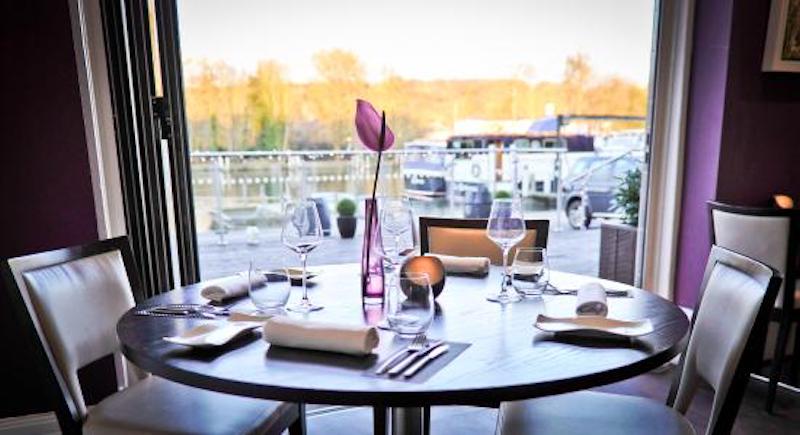
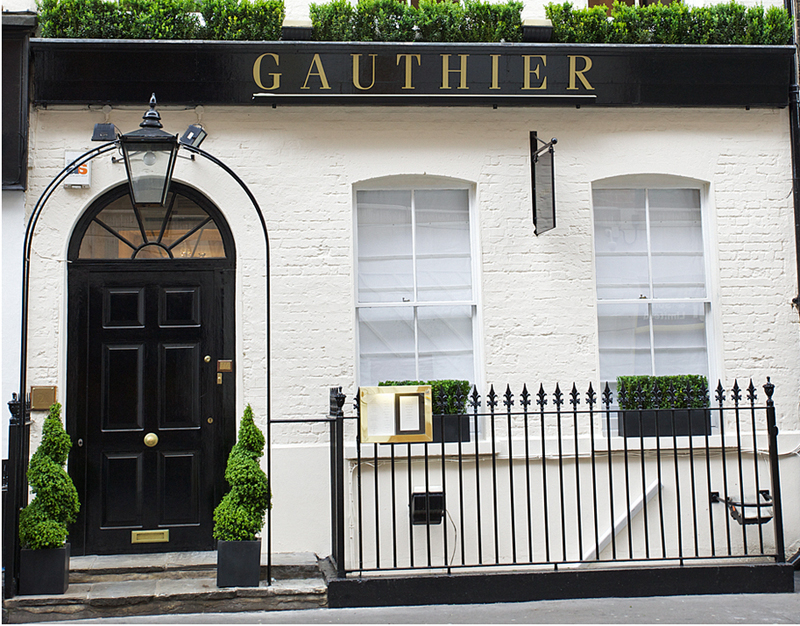
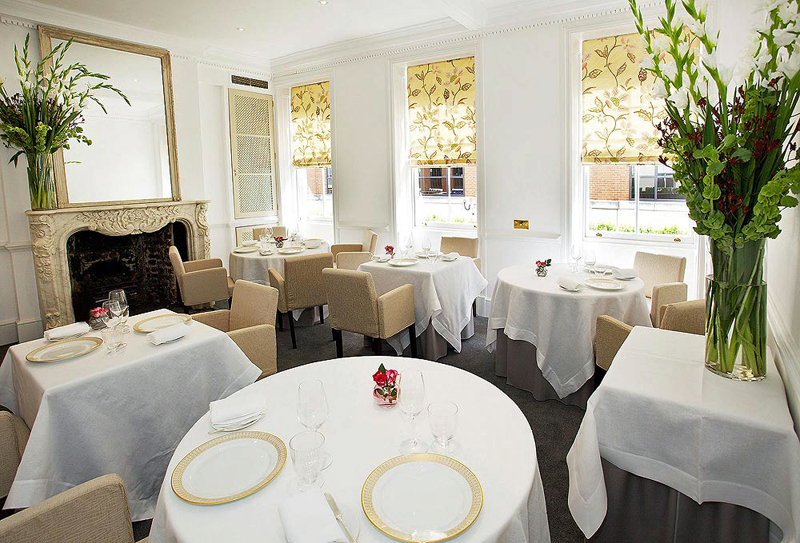
Set in a five storey terraced Georgian townhouse in Romilly Street, Gauthier Soho is a miniature maze of narrow staircases, uneven floors and varying sized dining rooms. This, indeed, is one of its many virtues – its smallness and intimacy. Ringing the bell of the glossy black door ensures a personal welcome before guests are shown to either of the two dining rooms – the Petit Salon on the ground floor or the Grand Salon on the first. (There are also two private dining rooms at the top of the staircase and a Chefs’ Room / wine cellar on the ground floor.) The high ceilinged, thickly carpeted rooms feature large gilt framed mirrors above the original marble fireplaces. Plain white walls form the backdrop to eclectic paintings and objets d’art. At lunch, ample natural light comes from the sash windows fitted with colourful floral blinds. In the evening, clever spotlighting supplements the dimly candlelit tables. Upholstered chairs in beige and well-spaced tables dressed in fine linen with monogramed napkins complete the elegantly designed salons.
gauthierupstairs

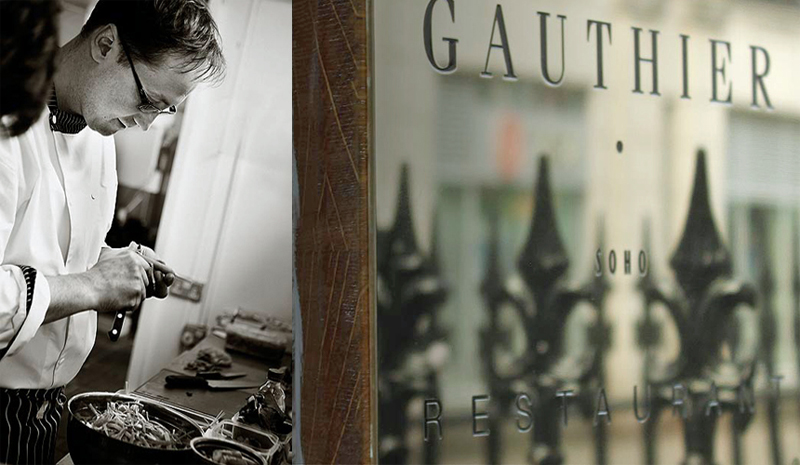
A disciple of triple starred Alain Ducasse at his Louis XV restaurant in Monaco (1993-6), Alexis Gauthier progressed to gaining his own Michelin star in 2000 at Roussillon in Pimlico, where he was head chef from 1998 to 2010. After opening Gauthier Soho in 2010 – which used to be Richard Corrigan’s Lindsay House – another star followed after a year.
GauthierSoho

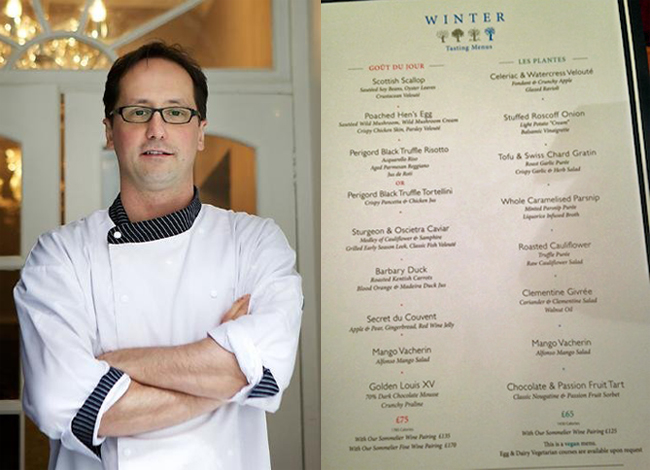
Passion is shown in Alexis’ inexhaustible creativity whilst being true to his classical roots. Invention is tempered with a sensitive caution, leading to unusual yet harmonious combinations in taste, texture and colour. Equal attention is paid to vegetables – Vegetronic, is his latest cookbook – as to meat and fish in the composition of dishes. Vegan dishes – highlighted in his Menu Les Plantes – also warrant serious consideration: where else amongst high end restaurants, could one eat a dish such as Tofu & Swiss chard gratin with roast garlic purée, crispy garlic & herb salad?

Precision comes from the accuracy of timing in cooking and in the balance of delicate flavours and contrasting textures. Uniquely amongst top chefs, Alexis rejects pre-weighing and timing in favour of judging by touch and sight. Such an instinctive approach demands far greater skill from his brigade of ten chefs. Where figures are called for, however, is in the calorie count for each dish, which is clearly indicated on the menu.

Perfection in the finished product is guaranteed. Menus change with the seasons, the ingredients being impeccably sourced. Generosity of spirit is evident in abundance: all dishes, even the smaller ones, are multi component, with distinct tastes identifiable. A conscious artistry is shown in their beautiful presentation. Attention to detail at every stage, from the dainty canapes with parmesan tuiles, through home baked breads to the delicious petit fours, is exemplary.

Nor is perfection confined to the food. The front of house team of nine, overseen by the understated resilience of restaurant manager Pierre Dumoulin, conduct a seamless operation, especially impressive given the cramped conditions and awkward shape of the rooms. Commis waiters negotiate the narrow staircase from the basement kitchen with sprightly step, allowing senior staff to present the dishes with considered aplomb. Service is correctly formal but not stiff, polite but not ingratiating, informative but not condescending. A suitable interval is allowed between courses, with diners’ requests often being anticipated – perhaps the acid test of excellent service.

With three sommeliers headed by Perrick Chapel, wines are taken seriously. The “dynamic and exciting” mainly French and Italian wine list avoids excessive mark ups. The restaurant also has its own thriving wine club. Assistant sommelier Domenico Barbieri, who served us presented, the flight of wines concisely, showing a real engagement with his craft.
GauthierMenu

The menu structure and price point are highly appealing, both gastronomically and financially. The carte, with three or four options at each stage, finishing with cheese or dessert, offers three, four or five courses for £50, £60 and £70 respectively. It is also possible to mix and match dishes from the same course. An eight course tasting menu, the Gout du Jour, featuring smaller versions of dishes from the carte, is competitively priced at £75. The vegan menu, Les Plantes, is £65, with wines pairings an extra £60 for each menu. Even better value can be had at lunch, where three courses with champagne, two glasses of wine and coffee is £45, or a four course tasting menu with champagne aperitif for the same price. Nor should we forget the free still or sparkling filtered water which is often charged for in lesser establishments. Certainly, no other high end West restaurant can match Gauthier Soho for prices and quality.

Fine Dining Guide visited on a busy Friday evening in early March to sample the tasting Gout du Jour.

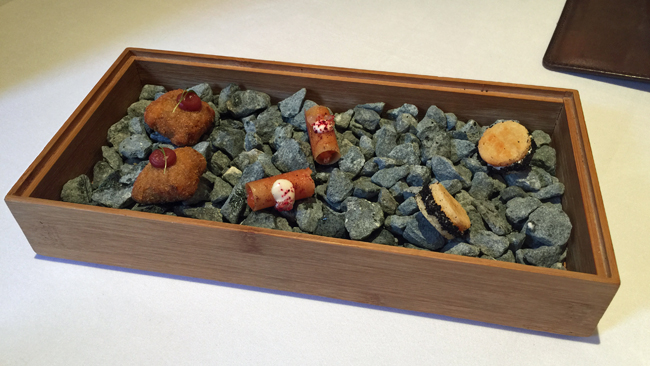
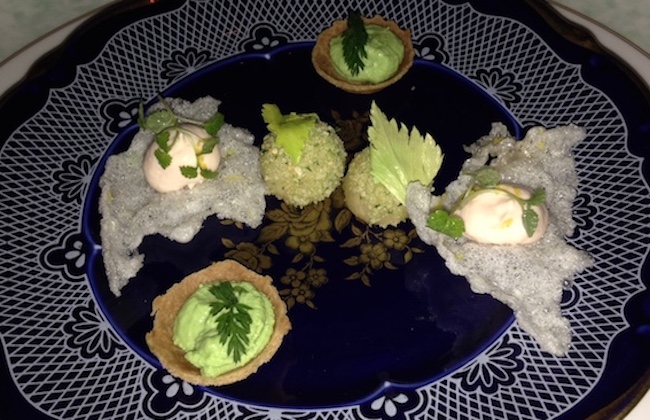
Well-made canapes served with an aperitif showed minute attention to detail. Delicate tapioca crisps with cod roe mousse, roasted celeriac with horseradish and ricotta and herbs tartelettes served their purpose in tantalising the palate with mouthful explosions of flavour without stealing the thunder of the courses to come.
Gauthier_Canapes

A selection of freshly baked breads, served with a generous pat of unsalted Normandy butter, included sour dough, basil and tomato focaccia, pain au lait with parmesan and red onions, and wild garlic brioche. They were exemplary in their crisp crusts, firm crumb and heady aromas and equally accomplished as those produced at Le Champignon Sauvage.

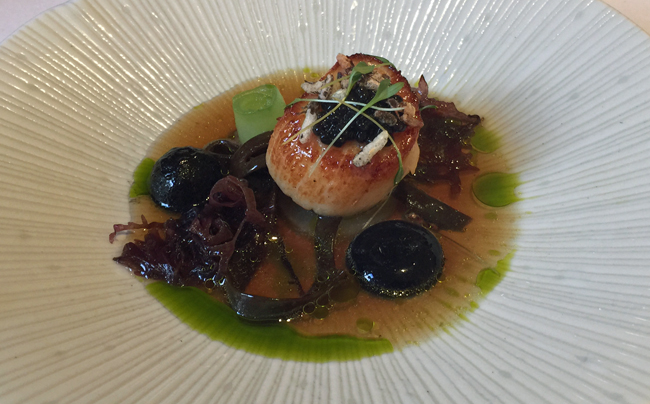
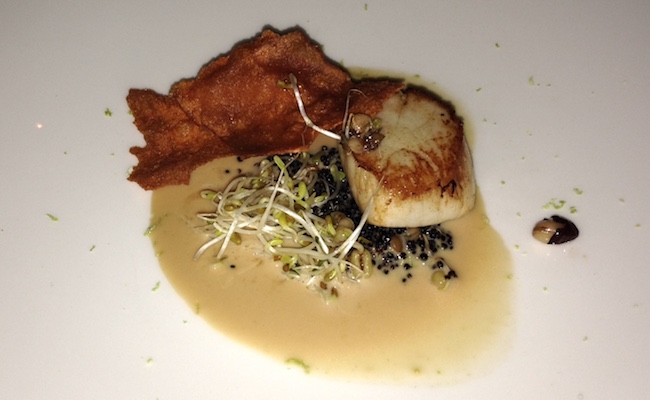
The first course saw a plump Scottish scallop, seared to produce a caramelised crust with meltingly soft, translucent flesh. Sauteed soya beans and oyster leaves added contrasting texture and freshness, whilst a deeply flavoured crustacean veloute, incorporating the scallop coral, lifted the dish. The firm acidity of the chosen dry white wine partnered the seafood well. (Wine: Savennieres-Roche-aux-Moines 2013, Domaine aux Moines)
Gauthier_Scallop

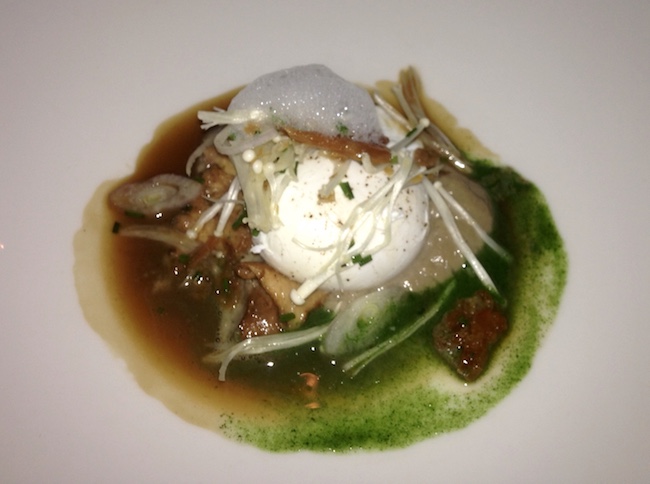
Next came a delicately poached hen’s egg, its golden yolk cascading over sautéed wild enoki mushrooms, wild mushroom cream and a dashi emulsion. These soft, earthy elements were balanced by a light parsley veloute and crisp chicken skin. The lively fruit flavours and juicy acidity of the paired wine worked well with this dish. (Wine: Alsace Pinot Gris 2013, Domaine Josmeyer <Le Fromenteau>)
Gauthier_Hen'sEgg

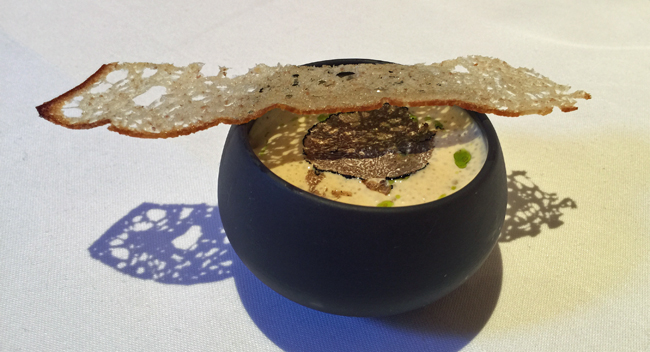
The third course featured a signature dish for which the restaurant has become renowned. An intensely fragrant Perigord black truffle risotto made from Acquarello rice, which absorbs more stock than other varieties without reducing it to a shapeless mush, was rich, creamy and moreish. Enhanced by aged Parmesan Reggiano, and Jus de roti, the earthy depth of flavour was stunning. The sherry- like Jura wine, with its spicy, almondy finish, was another inspired pairing. (Wine: Cotes du Jura 2012, Domaine Daniel Dugois)
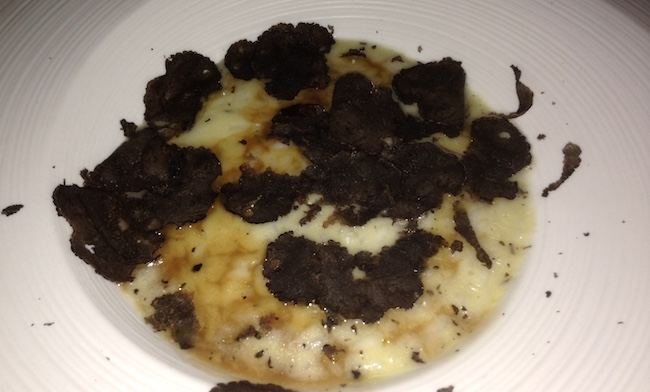
gauthier_BTRisotto


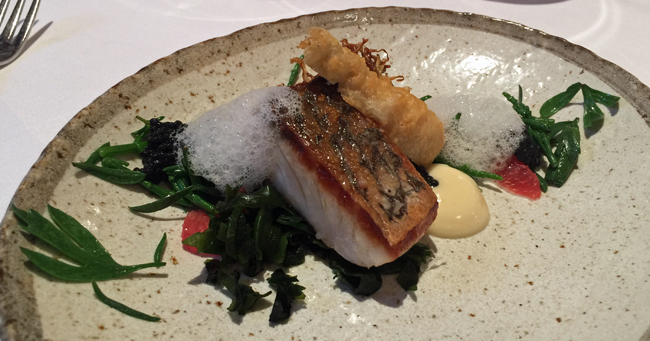
It was interesting and unusual to be offered Sturgeon for the fish course. The pronounced piscine flavour and soft texture of this freshwater fish, timed to retain its succulence, was balanced by the relative subtlety of crisp cauliflower florets and smokiness of grilled early season leek. This dish was finished with a classic fish veloute and an appropriate luxurious garnish of Oscietra caviar. The light Pinot Noir style of the Austrian wine proved a suitable match. (Wine: Weinland 2014, Domaine Gutt Auggau <Atanasius>)

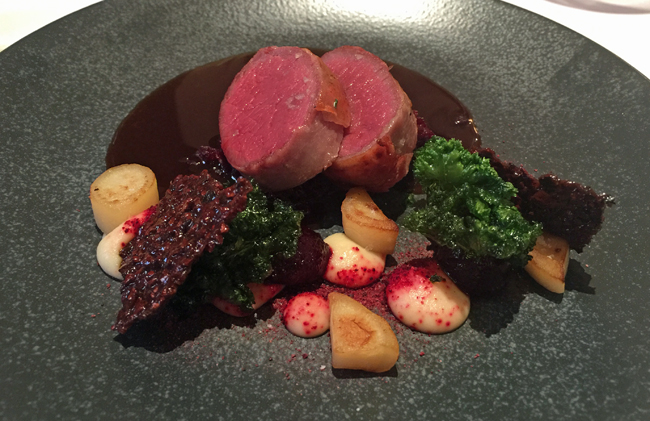
The meat course showcased the deep, sweet gamey flavour of Barbary duck in two ways. The thick breast, roasted to a medium rare, and shredded, meltingly soft confit leg. Garnished with roasted Kentish carrots and finished with a silky blood orange puree and a rich Madeira duck jus which lifted the whole dish, this was a simple yet accomplished dish. The full bodied red wine, high in tanin, complemented it well.  (Wine: Coteaux du Languedoc-Montpeyroux 2003, Domaine Alan Chabanon < L’esprit de Font Caude>)
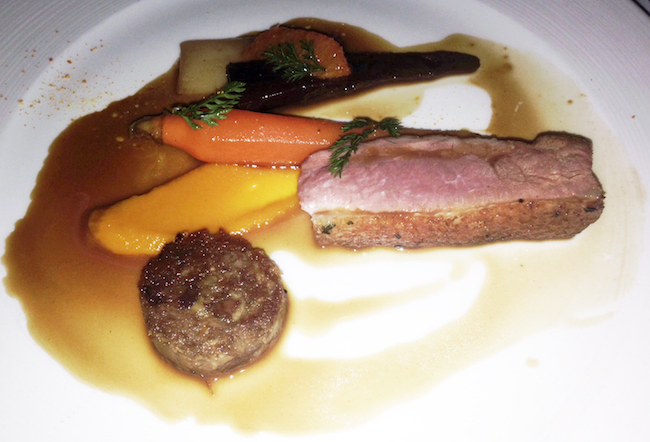
Gauthier_Duck

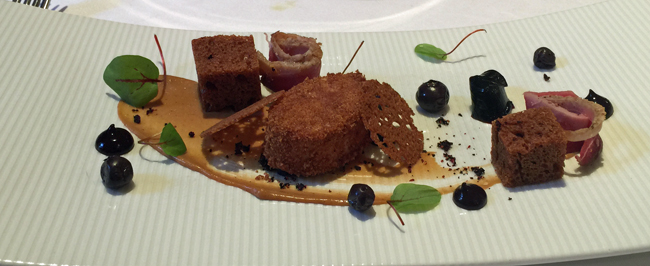
The cheese course presented a slice of the unusual Secret du Couvent with its dense, semi firm texture and heady fragrance. Gingerbread, tiny apple and pear balls with red wine jelly and a balsamic reduction set off the creamy savouriness of the cheese, as did the caramel notes of the accompanying dry Madeira. (Wine: Madeira 10 yrs, Blandy’s <Sercial>)

Mango vacherin demonstrated the undoubted strengths of the pastry section. A golf ball size of crisp, delicately thin French meringue encased an aromatic sorbet of Alfonso mango. Dressed with drops of mango coulis and tiny cubes of fresh mango given a herbal lift, this light, refreshing dessert, partnered with a sweet New Zealand Riesling was a fitting prelude to the richer finale to come. (Wine: Marlborough Valley 2014, Framlingham <Select Riesling>)
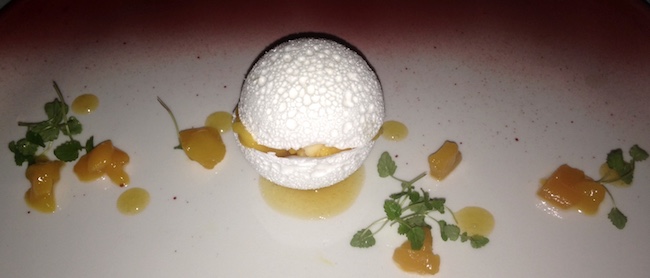
Gauthier_MagoVacherin

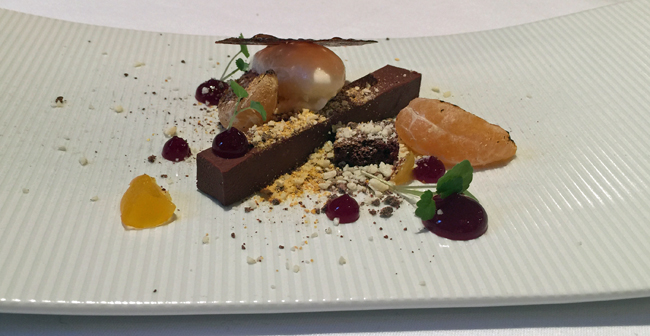
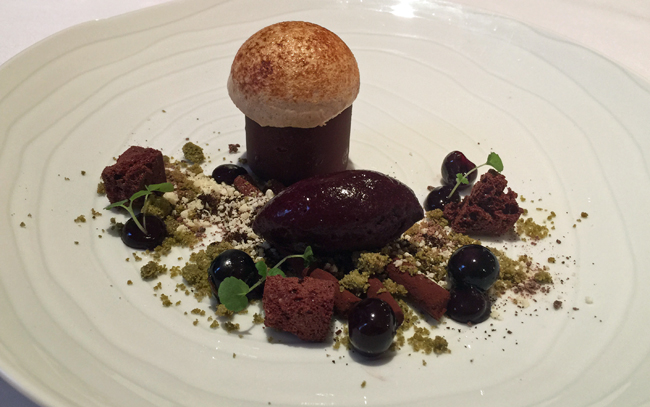
Not having dined at Louis XV in Monaco, my first acquaintance with its eponymous dessert was by watching a TV programme in which Alexis Gauthier, who was Alain Ducasse’s pastry chef, championed it as the greatest dish in the world. If imitation is the sincerest form of flattery, Alexis makes no apology for making it his signature dessert. Having eaten it several times at Gauthier Soho, I can see why it is seen as a dessert lover’s dream. Discs of crisp praline dacquoise topped with a 70% dark chocolate mousse, enveloped in a glossy ganache paradis and decorated with gold leaf formed this rich but light confection that oozed elegant, sophisticated indulgence. Although it is notoriously difficult to pair chocolate with wine, the selected Uraguayan sweet red, combining two different techniques for dessert wines, Barolo Chinato and Marsala, proved a perfect match. (Wine: Calenons N-V, Vinendo de los Vientos <Alcyone>)
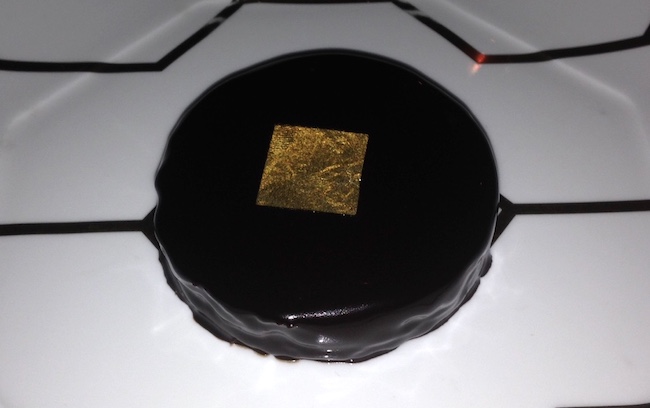
Gauthier_Chocolate

Good coffee and petit fours completed this memorable meal, enhanced by the select flight of wines and impeccable service.

Why Michelin decided to withdraw its star defies belief. Not that Gauthier Soho needs a star to attract custom – it has already proven its worth. Certainly, the healthy numbers of diners, on average 25-30 for lunch and 45-50 for dinner, amongst whom there are a high proportion of regulars, testify to its success. Nevertheless, in the often unintelligible and unfair world of restaurant guides, a major injustice remains uncorrected. Fine Dining Guide will continue to visit this remarkable restaurant, and will follow its progress with interest.
Hélène Darroze at The Connaught, New Sunday Menu (Press Release March 2017)

Posted on: March 7th, 2017 by Simon Carter

helenedarroze

HÉLÈNE DARROZE LAUNCHES “LE POT-AU-FEU DU DIMANCHE” MENU AT THE CONNAUGHT

Following the huge success of the “Le Poulet du Dimanche” menu over the past year, Hélène Darroze has launched a new five-course Sunday tasting menu – “Le Pot-au-feu du Dimanche” at her eponymous restaurant at The Connaught in London’s Mayfair.

“Pot-au-feu”, which means “pot on the fire”, is a traditional beef stew from the south west of France and is the epitome of French family sharing cuisine. The new menu showcases the main elements of the classic dish, deconstructed with Hélène’s personal flair and a few select luxury ingredients. The menu features the following:

  • Roasted bone marrow with a parsley crust, caviar, capers, pickled shallots, Meyer lemon, gem lettuce and a salad of fine herbs
  • Charred leeks with saucisson Lyonnais, leek velouté, and Périgord black truffle
  • Lake District Farm beef fillet, foie gras from Les Landes, confit pork belly, veal sausage, and a traditional bouillon perfumed with ginger and lemongrass
  • A salad of light gêlée of beef consommé, confit terrine of brisket and oxtail, young vegetables, horseradish and grain
  • A twist on the classic lemon tart – Candied Meyer lemon, sablé breton, coriander and lime emulsion

Passionate about classic French dishes from her home region, Hélène Darroze commented: “I have so many wonderful memories of my grandmother’s pot-au-feu on a Sunday – I loved the hearty richness of the dish, and the fact that there were always leftovers to turn into a salad the next day. My own version at my restaurant may be a little bit fancier with some shavings of truffle and a little bit of caviar, but the heart and soul of the traditional dish and all its gutsy ingredients remain.”

“Le Pot-au-feu du Dimanche” is now available at Hélène Darroze at The Connaught every Sunday for lunch from Noon-3pm and dinner 6.30pm-9pm, and will be priced at £75 per couple (the menu is designed for two to share). The menu must be pre-booked as availability is limited.

Since 2008, Hélène Darroze has been bringing her signature style of exquisite, contemporary French cuisine to The Connaught. India Mahdavi designed the sophisticated but comfortable Michelin two-starred restaurant. Hélène is known for her obsession with exceptional ingredients, and always forges very strong relationships with her French and British suppliers. In 2015, she was named the Veuve Clicquot World’s Best Female Chef, and she has also been awarded the Order of Chevalier three times, one of the highest decorations in France. Her well-established Paris restaurant on the Left Bank – Hélène Darroze – opened in 1999, and holds one Michelin star.

Address: Hélène Darroze at The Connaught, Carlos Place, Mayfair, London W1K 2AL Reservations: 020-7499 7070

Website: www.the-connaught.co.uk/mayfair-restaurants/helene-darroze/ Twitter/Instagram: @HeleneDarroze @TheConnaught

For more press information, contact:

Network London PR – Maureen Mills, Jessica Corrigan or Tom Rogers

Tel: 020-8947 4474, or Email: info@networklondonpr.com                                                              March 2017

The Kitchen at Chewton Glen (Press Release March 2017)

Posted on: March 6th, 2017 by Simon Carter

chewtonkitchen

The Kitchen – A New Restaurant at Chewton Glen

Later this month, Chewton Glen, one of the UK’s finest country house hotels, will officially launch The Kitchen. The handsome new-build space in the grounds of the New Forest property will have a dual purpose – a cookery school overseen by celebrity chef James Martin which will launch on 1st April 2017, and a 42-seat informal restaurant will open its doors on the 14th March 2017.

Offering a menu of casual comfort food classics, often with a touch of luxury, ranging from wood-fired pizzas and gourmet burgers to healthy superfood salads and indulgent desserts, The Kitchen’s open-plan interior will not only showcase chefs at work, but also provide a glimpse into the day-to-day activity in the busy adjacent 12-station cookery school.

Chewton Glen’s Adam Hart has been appointed Head Chef, and has devised the British-influenced menu in consultation with the hotel’s Executive Head Chef Luke Matthews and additional input from James Martin, particularly on some of his own well-loved signature specials.

Local sourcing is crucial, and as well as British artisan charcuterie (on a create your own board), fish is from the south of England, and cheese from Hampshire and Dorset. Chewton Glen’s own gardens will provide a ready supply of vegetables, fruit and herbs – and guests will be encouraged to visit with the hotel’s own foragers and gardeners.

The lounge area will be perfect for snacks or a lighter grazing experience, and a spacious outdoor terrace will also be available for al fresco dining. Options will include Pea and mint croquettes with English feta; Gin and tonic scampi; and Deep-fried aubergine with caramelised miso. (Prices from £3.50-£5.50.)

Typical dishes on the seasonal main menu will include – Salt and pepper Brixham squid (with dashi dressing); Cornish mussels with Laverstoke Park chorizo; Salad

of chargrilled tiger prawns (with kohlrabi, celeriac, dulse, ginger and spring onions); Trenchmore Wagyu beef burger (with field mushrooms and truffle mayonnaise); a variety of Sourdough Pizzas (such as with Artichoke, asparagus, Flambards eggs and Dorset truffle, or Nduja, fennel, rosemary sausage and black olives); and a few Chargrills – such as Salt-aged Udale ribeye, Spatchcocked chicken; and Wood-fired whole seabass (with watercress salsa verde). Tempting desserts will feature a Classic lemon tart with crème fraîche; Sticky toffee pudding with toffee sauce; Rum Baba with Chantilly cream; and a selection of Laverstoke Park ice creams.

Prices for the à la carte menu at lunch and dinner will be from £7.50 for charcuterie; £17 for superfood salads; from £12 for burgers; pizzas from £10; grills from £18; and all desserts at £6.

There will be a compact, international 42 bin wine list with many selections from small growers (bottles from £20), with all available by the glass (from £4) or 500ml carafe (from £16). In addition, there will be an extensive cocktail list that incorporates some local area whiskeys, gin and vodka, plus a range of local and craft beers.

Stylish, informal, family-friendly, relaxed and professional – these are the hallmarks of The Kitchen, and synonymous with Chewton Glen’s enduring award-winning style.

Address: Chewton Glen, Christchurch Road, New Milton, Hampshire BH25 6QS Reservations: 01425 275341

Website: www.chewtonglen.com/thekitchen/ Twitter/Instagram: @TheKitchenatCG

The Kitchen at Chewton Glen (Press Release March 2017) by Angela Day and Network London

Atul Kochhar: Chefs Season 2017 (Press Release)

Posted on: March 4th, 2017 by Simon Carter

Atul Kochhar Chefs Season

Twice decorated Michelin-starred Chef Atul Kochhar announces the start of his 2017 Chef Season in which he will welcome a list of fellow chefs into the kitchens of Sindhu and Indian Essence.

Once a month diners will experience a collaborative six-course Tasting Menu created by Atul and some of the most celebrated names in the culinary world.

Each chef will present three dishes alongside Chef Kochhar’s three that will promise to delight the palate and awaken the senses of guests. For a flavour of these highly anticipated events please see the full list below.

Commenting on the specially curated season, chef Kochhar said: “I am excited to welcome such a variety of talented chefs. The mix of skill, passion and creativity is outstanding. Here are chefs who, like me, promote and encourage seasonal British ingredients as well as Indian, Italian and South Asian. It’s important for me to adapt and adopt – cultures, cuisines, ingredients, everything. To bring diverse cultures closer, this is what food is about and these chefs understand and demonstrate these same important principles. So let’s get cooking!”

Future dates and chefs to be announced. Please check www.sindhurestaurant.co.uk and www.indianessence.co.uk for further information.

Chef Season Diary

Aktar Islam of Lasan Group

21st February at Sindhu Restaurant and 22nd February at Indian Essence

Birmingham born chef Aktar Islam from the Lasan Group is renowned for his creative passion of South Asian cuisine. Winner of The Great British Menu in 2011, his influence and distinctive style using exotic flavour combinations was borne from his culture and heritage. Aktar’s passion for creating modern South Asian cuisine has ensured his meteoric rise as one of the most talented chefs in the UK.

“I’m driven by the desire to create innovative modern dishes that bring together quality local produce with the intricate flavours of the Indian subcontinent.” Aktar Islam on Twitter @aktarislam | http://www.aktarislam.co.uk

Ping Coombes

15th and 16th March (Sindhu only)

Chef Ping Coombes is a home cook who rose to fame after winning the coveted MasterChef trophy in 2014. Growing up in Ipoh in Malaysia, a city renowned for its street food and exotic Malaysian cuisine, Coombes moved to the UK in 2000 and since winning the coveted MasterChef title has created a successful career in the food industry, showcasing Malaysian food and techniques to a mass audience via special appearances, food demonstrations and her cook book Malaysia: Recipes from a Family Kitchen.

“I want to continue to learn more new skills and techniques, adapting them to East Asian cooking, and to introduce the UK to more Malaysian flavours.” Ping Coombes on Twitter @WanPingCoombes | www.pingspantry.co.uk

Jane Devonshire

26th April at Sindhu Restaurant and 27th April at Indian Essence

Jane Devonshire comes from a family of cooks and her talent, skill and energy for food was demonstrated when she won the MasterChef title in 2016. From a very young age her passion for food was evident and it was this drive and determination that caught the eye of John Torode and Greg Wallace. Janes’ passion for food thrives as she continues her extraordinary culinary journey creating fuss-free recipes and delicious meals for the home cook.

“I’ve had a life-long passion for food but appearing on MasterChef meant stepping out of my comfort zone. Food is an absolutely solid and integral part of my family life, both growing up and now. It represents so much more for me than just food; it’s family and friends – the best times are always when good food, family and friends surround you.” Jane Devonshire on Twitter @janecdevonshire www.janecdevonshire.com 

Dominic Chapman from The Beehive Pub & Restaurant

9th May at Sindhu Restaurant

As a self-confessed traveller at heart Dominic Chapman has a love of world cuisine, with Indian food holding particular significance. Every year the chef travels to India and spends two weeks cooking in the kitchen of an existing restaurant. Once head chef for Heston Blumenthal, Chapman has a less molecular style than his former mentor, instead serving up beautifully prepared, comforting dishes made with quality local ingredients. He won a Michelin-star at The Royal Oak in Maidenhead before becoming chef proprietor at The Beehive in White Waltham. With his love and appreciation for Indian cooking, Chapman was a natural selection to join chef Kochhar for Chef Season.

“I use traditional cooking methods to create seasonal and delicious dishes. I’m passionate about seasonal ingredients cooked simply. British ingredients where possible, but I don’t want to be restricted by them.” Dominic Chapman on Twitter @DomChapman www.thebeehivewhitewaltham.com

Cyrus Todiwala of Café Spice Namasté and Mr Todiwala’s Kitchen

11th May at Indian Essence and 29th June at Sindhu

Cyrus Todiwala is a chef, restaurateur, author and TV personality. The Bombay-born Parsee chef is recognised for his hallmark style of blending traditional Indian culinary techniques and flavours with more unexpected ingredients, as well as his hand-made line of pickles and chutneys (Mr Todiwala’s Splendidly Spicy and Deliciously Hot Pickles and Chutneys) which are food festival favourites. He is Proprietor and Executive Chef of Café Spice Namasté and Mr Todiwala’s Kitchen in London and is known for his innovative and fresh approach to Indian Cuisine.

“I always think to myself ‘How can I do something different this time?’, that’s how you can create something completing out of the ordinary. The best inspiration comes through trying new things.” Cyrus Todiwala on Twitter @ctodiwala | www.cafespice.co.uk  

Restaurant Review: Sindhu by Atul Kochhar, Marlow (Feb 2017)

Posted on: March 1st, 2017 by Simon Carter

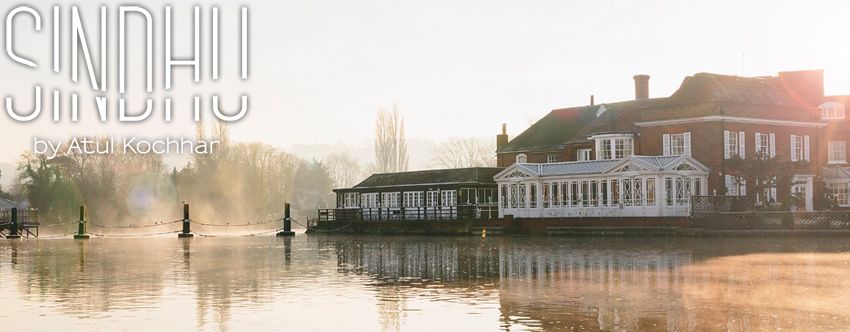
sindhu exterior

Atul Kochhar has been in the vanguard of transforming Indian food from the traditional curry house staples into the sophisticated, elegant cuisine of contemporary fine dining. Having won Michelin stars first at Tamarind (2001) and then at Benares (2007), his career has seen openings of Sindhu restaurants on three P&O cruise ships, a partnership with Jatindar Singh at Indian Essence in Orpington and, since December 2014, a franchise at Sindhu in the Compleat Angler Hotel in the historic Thameside town of Marlow, Buckinghamshire.

The 2017 Good Food Guide lists four entries with marks of 5/10 or above for this relatively small town, no mean achievement given the exacting standards of this publication. That “Marlow is the new Ludlow” is now indisputable. It has seen a veritable flowering of destination restaurants in the last decade, including the Hand and Flowers, the Coach, Vanilla Pod and the nearby Danesfield House Hotel. On a site once occupied by Aubergine, overseen by Michelin starred Billy Drabble, Sindhu is emulating its success with 6/10 in the GFG with two AA rosettes.

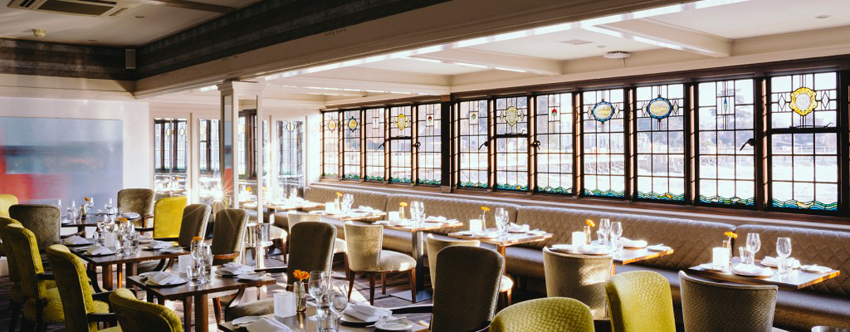
Aptly taking its name from the Sanskrit for the Indus River, Sindhu boasts commanding views of Marlow weir. Insulated from the sound of cascading waters, the carpeted dining room is a stylish blend of traditional features – stained glass on the leaded windows, dark wood panelling and real log fire – with more contemporary touches such mirrored columns, spotlighting and abstract canvasses which punctuate the green grey décor. Bold fabrics used in the lemon and turquoise upholstered chairs and in the glitzy banquette which runs the full length of the restaurant provide comfortable seating around well-spaced, polished dark wood tables.

Sindhu Interior

Just as the setting offers a mixture of old and new, so Atul Kochhar’s cuisine matches the authenticity of Indian cuisine – there is extensive research into the regional dishes of the subcontinent – with innovative modern British touches both in preparation and presentation. Spicing is subtle rather than bold, maximising flavour without excessive heat. Top quality ingredients are allowed to shine, with saucing enhancing their natural qualities. Timing is skilfully judged, whether in slow cooked or dishes needing less time. Combinations of ingredients can be unusual and exciting but always harmonious. The food is attractively displayed on a variety of surfaces including slate, wood and porcelain.

Menus include the full carte, featuring signature dishes such as soft shell crab, lamb shank and lamb cutlet, the highly popular seven course tasting menu (£65) and a good value weekday set lunch (at £19 for two courses and £22 for three).  Prices are fair, given the outstanding quality of the ingredients, such as Scottish scallops, Atlantic halibut and Romney Marsh lamb, and the skilful, innovative cooking. Menu descriptions are sparse, listing the main components with little information of cooking techniques, thus allowing for an element of surprise when the dish is served.

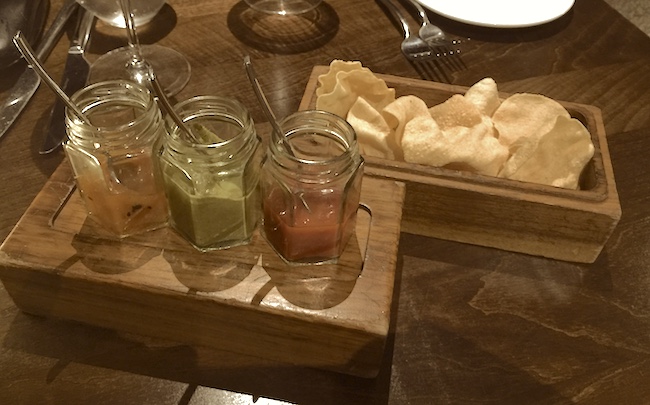
Connoisseurs will be impressed by the select and informative wine list. There is a good selection from Old and New Worlds with excessive mark-ups being avoided. The cocktail list also includes six non-alcoholic options. The Ginger Feast, with pressed pineapple and fresh lime spiced with fiery ginger beer was especially refreshing, and a pleasant accompaniment to the delicate bite sized lentil poppadoms with a trio of mango, tomato and coriander chutneys which started the meal.

poppadoms

The tasting menu, which we noticed many diners were choosing, proved the perfect introduction for those unfamiliar with Sindhu’s repertoire.

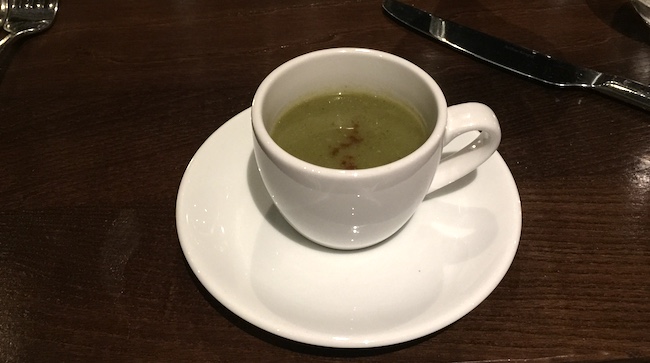
An amuse bouche of leek and potato soup fused a classic English starter with gentle Indian spicing, tantalising the palate with moderate heat and a long finish.

Sindhus amuse

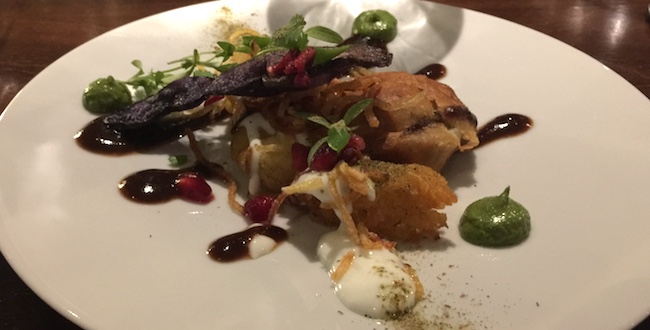
The first course of Aloo and Samosa Chaat, combined two staples from Northern India. This flavoursome dish of roasted sweet potato encased in crisp pastry, and crisp deep fried new potato was enlivened with dressings of yogurt, tamarind and mint, with a scattering of pomegranate seeds for sweetness and colour.

starters sindhu

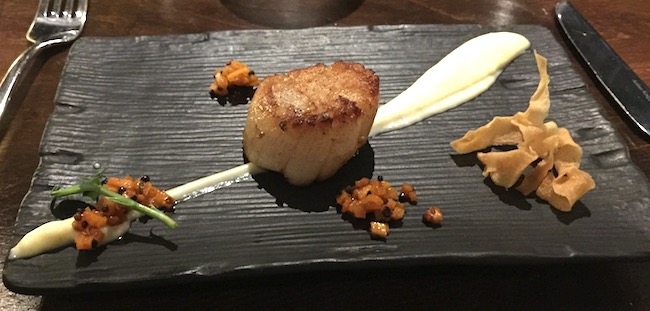
Next came Jal Tarang showcasing a large, beautifully fresh Scottish scallop, precisely timed to produce a caramelised crust and sweet, succulent flesh. What transformed this essentially modern British offering, with its velvety parsnip puree and deep fried crisps into a unique Kochhar creation was the spicy but not overpowering parsnip pickle, which lifted the whole dish. Set on dark slate, the contrasting colours of the ingredients also made this a visually appealing dish.

SindhuScallop

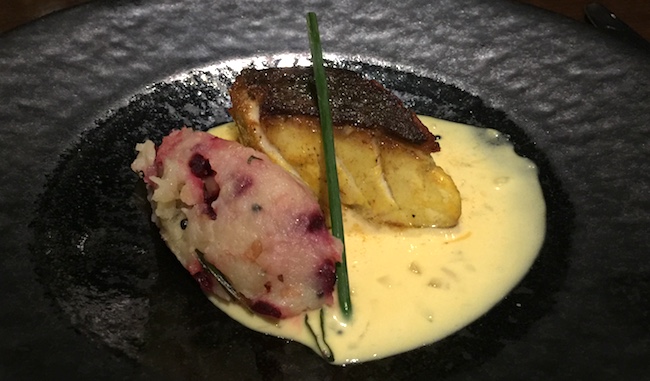
Equally accomplished was Meen Moilee, reflecting southern Indian influences. Here a fillet of Stone Bass – underrated but equally delicious as its better known cousin Sea Bass – was cooked to perfection with crisp skin and flakes of meltingly soft flesh. The balance of this dish was well judged, the freshness of the fish contrasting with the earthiness of a crushed potato and beetroot quenelle, with a rich coconut sauce, flecked with fresh coconut, bringing the other elements together well.

stonebass

Lime sorbet provided a cooling citrus hit before the meat courses. Although, sadly, sorbets as an intermediary course has almost disappeared from modern British tasting menus, here it is entirely appropriate, allowing the palate to revive from the variety of tastes and textures which preceded it.

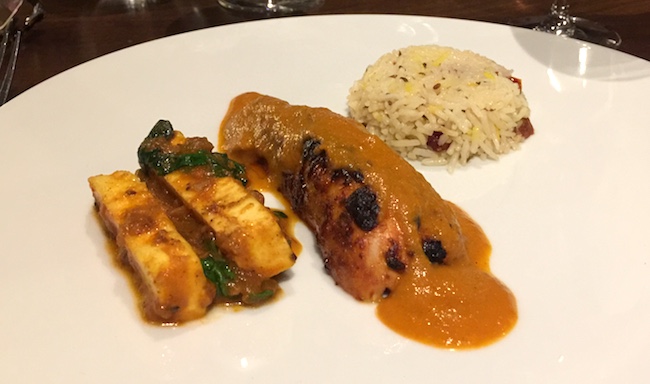
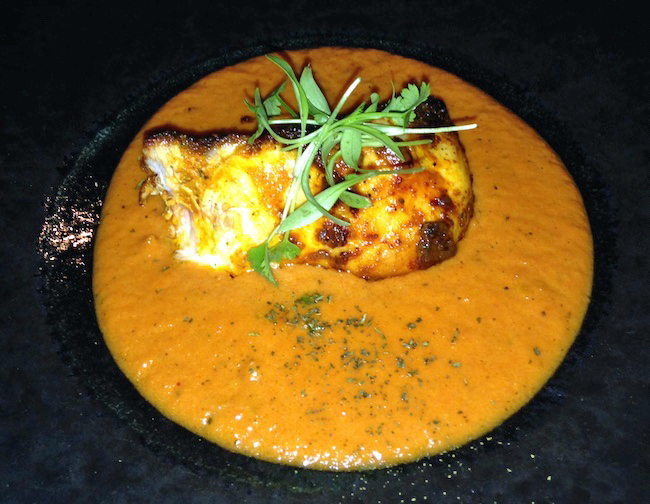
A northern dish of Murgh Makhanwala presented strips of succulent, smoky tandoori chicken supreme enhanced by a gently spiced and sweet Tomato Pulao, laced with butter and saffron. Raisin pilaf and paneer with spinach proved excellent foils for the richness of the chicken, soaking up the complex flavours of the sauce.

sindhu chicken

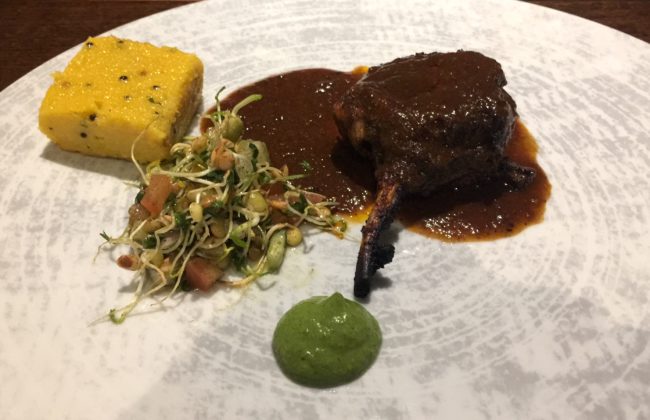
Erachi Chettinaad from the Tamil Nadoo region in south eastern India has proved to be a popular signature dish. A grilled cutlet from a Romney Marsh lamb, noted for its extra marbling, had been marinated in a Chettinaad mix of 21 spices to produce a sauce which, amazingly, complemented rather than overwhelmed the juicy, full flavoured lamb. Again, such deftness in the use of spices is the hallmark of Atul Kochhar’s gastronomy. A portion of dry polenta provided the necessary starch element whilst a dressed Kachumber salad of cucumber, tomato and bean sprouts and mint raita added a crisp freshness to offset the more aromatic elements.

lamb sindhu

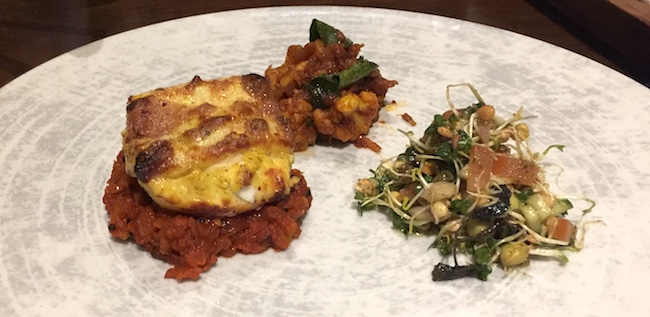
Chapa Pulusa, a southern dish, featured a grilled fillet of Atlantic Halibut, the firm flesh of which was suitably partnered with caulifower Pakora and chickpeas. A Tamarind sauce, with its sweet and sour qualities, worked well with the robust textures of the fish, vegetable and pulse.

halibut sindhu

The accompanying warm nan bread was soft and light, the perfect vehicle for mopping up the delectable sauces and the slow cooked Black dahl with its deep, smoky flavour.

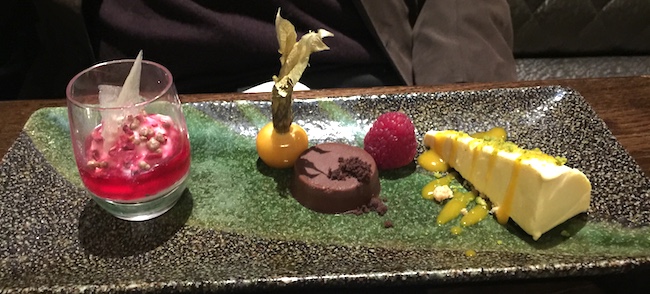
The final course was a trio of well executed desserts. Bhapa Doi, a delicate yogurt cheesecake with rose water added sparingly so as not to be overpowering. Mango Kulfi was light, creamy and full of fruit flavour. And chocolate and passion fruit disc was dark, intense and fragrant.

dessert sindhu

Coffee and petit fours completed this memorable meal, the service of which was seamless, dishes arriving with a well-judged interval between courses. It was overseen by deputy manager Jaspreet who was welcoming and informative, especially on the origin of the dishes. Although we only drank a glass of red wine with our meat courses, it was clear that Mark, the Sommelier who was busy serving other tables the full flight of wines, was an accomplished practitioner of his craft.

Overall, Sindhu is a class act in all respects, a distinctive addition to the Marlow food scene. The lively buzz of contented diners in a relaxed atmosphere reflects a strong local following with increasing numbers from further afield. A healthy weekday evening average of 30-35 covers, and full capacity at weekends, clearly testify to the popularity of Sindhu in a highly competitive market in the affluent Thames Valley. Fine Dining Guide will visit again to sample other dishes from the carte and will monitor Sindhu’s progress in the guides with interest.

Interview: Andrew McKenzie, MD The Vineyard Group (Feb 2017)

Posted on: February 20th, 2017 by Simon Carter

Andrew McKenzie fell in love with the hotel industry when, as a young boy, he successfully worked as a hall porter at a hotel in his home town.  After entering the hotel trade full-time Andrew embarked upon a journey which led him to The Vineyard Group.  Here, Andrew shares his knowledge and experience of near twenty years at the helm of this prestigious hotel group.

Andrew McKenzieTell us some personal and professional background about yourself
Having started on a paper round, I graduated at the age of thirteen to being a hall porter in a hotel in my home town in Scotland – The Royal Hotel in Bridge of Allan – I learned very quickly that if you are nice to people then in return they may give you some money; I made more in tips than I did in wages! That principle is the essence of hotel keeping.

I came from a typical Scottish working class, council house background but found the glamour of top hotels infectious – the seductive imagery of silver, crystal and jackets with tails – After leaving school, I started working at hotels around the UK, with the hotel companies getting gradually smaller – from the world-wide Inter Continental brand through to De Vere through to Shire Hotels (who owned The Stafford in London as part of Daniel Thwaites).

While the property at The Vineyard was being built, I came on board as second to the MD to originally run Donnington Valley. As it turned out the top position became available within a month after the opening, so around 19 years ago Chairman Sir Peter Michael made me Group MD and I’m still here and enjoying (nearly) every minute!

How has the market evolved for The Vineyard?

Our Chairman (Sir Peter) has a saying about his business: 100 by 100 in that it should be 100% family owned and last for 100 years. We’ve had our share of tough times here and that long view has been critical to lasting success. We realised that we needed to punch above our weight to sustain ourselves – wine and gastronomy in that discerning individuals would be at the heart of the identity but also offering a country retreat for small groups within city corporates and tech companies for business related purposes.

Vineyard

Monday through Thursday, there’s not a lot of tourist trade coming to the outskirts of Newbury, and the price point is outside the limit of travelling businessman, so when the credit crunch hit, it hit us hard. As an example, we used to sell higher value wine in good quantities but that market declined without our cost base particularly changing, so we’ve had to adapt, be more flexible and accessible to a wider client base.

The key benchmark we’ve set is not to compromise on quality: An example is making wine available by the glass, the better the quality of wine the better for the customer, the better for the business. To facilitate this we have the Coravin wine preservation system and offer over 100 quality wines by the glass. The sommeliers know how to match wines with the food or vice versa and importantly, are always recommending; which actually makes them the best wine preservation system!

In general, the Group is continually evolving to match the needs of the evolving market.

How would you describe your roles and responsibilities?

My five days a week role is strategically focused but I love a taste of working the floor in the property on a Saturday, as that was the element that seduced me into the industry in the first place. To give you an idea of the scope and size of the operation; originally there were 33 bedrooms at The Vineyard, now there are 49. At Donnington Valley there were 58 rooms and now there are another 56 plus a health club and spa. The Group has also recently acquired a hotel in Bedford, runs and owns two golf courses and a wine merchant business. We also manage two hotels on behalf of other owners but are looking at another two. So plenty to keep me busy!

What is your philosophy of people management?

Naturally, we want to employ warm, friendly people and nurture their talent and encourage the right attitude.

Should a staff member not be doing something correctly then their manager should first consider whether they have actually told them what they should be doing.  If they have told them but the staff member is still not doing the task right then the manager should consider whether they have properly shown them how to do it.  If they have told them and shown them and they’re still not doing it right then use discipline.  In essence, there are only three reasons why something goes wrong – communication, training or misconduct and in the vast majority of times it is the first case and only very few in the last.  We’re actually fortunate in that the hospitality environment is largely self-policing: If you don’t turn up for work on a Thursday morning for any wrong reason, then you leave your friend in trouble for having to cover for you so that tends to naturally take care of itself.

I call service ‘organic’ in that bespoke service is required for each guest – one size does not fit all – an example might be two couples in the bar from 7.45pm for pre-dinner drinks to be taken through to their table at 8.15pm. At the end of the meal both parties complain – one for being rushed, the other for service being slow – each had experienced the exact same process.

It is our job to proactively anticipate these different needs by carefully monitoring the customer experience so that each party receive exactly what they want without even having to ask us. Along similar lines the objective is to provide standards without standardisation.

For staff development and encouragement we must match and better what is out there in the market. To compete for the best talent, we offer all our staff regardless of their role WSET training. Our team of seven sommeliers are encouraged to visit wineries, attend tastings and enter awards and competitions to develop their skills. Key individuals are given a monthly budget to visit competitors and write a full report to benefit them and the company.

We also run a very popular Employee of the Year award. The team vote across the Group, a winner of each property is decided with the chosen three having a lunch with our owners and past winners. The executive team decide the order. The overall Employee of the Year receives a trip for two to Sir Peter Michaels Californian winery. Second prize is Eurostar to Reims for two nights with a hosted tour and lunch at Taittanger and third prize is a two nights stay in a Relais & Chateaux of their choice in the UK. The whole process is motivational and educational in so many ways for a large hard working team.

A mantra we have in the Group is that knowledge is cool, we encourage nerdiness; there is an expectation that to be best in class we need to have the utmost knowledge about our product to enable us to provide the right level of service to our guests. From the art on the walls, through the food on a plate to the wine in the bottle, we believe in equipping staff with knowledge. Numerous training opportunities are provided and the accolades that go with achievement are also proactively encouraged.

What are the perceived implications of Brexit on your business model?

So far no impact whatsoever, however a three pronged concern. First is the impact on our city based corporate customers who may become increasingly nervous and so stop spending, second is our staffing situation, third is currency fluctuations that may make wages less attractive to our overseas staff and Californian wine more expensive.

While around 40% of our staff are from the EU, that figure increases to around 80% for those who are customer facing. Essentially, when Eastern Europe opened up, it saved the bacon of the hospitality industry. Prior to that, there was less a recruitment shortage and more a recruitment black hole. While the trade deal is important to the country, the movement of labour is key for this industry – merely allowing people already here to stay wouldn’t be a solution as there is natural churn. If the solution proposed is the same as currently exists for Non-EU countries then the wage bill of that source of labour will also become non-competitive for our business.

All in all, interesting times, it will be what it will be and we will deal with it.

Zero Hour Contracts are found more in hospitality than any other industry, what is your view on them?

There’s unnecessary confusion about Zero Hour Contracts. The hospitality industry has always worked with casual labour and this contract simply facilitates this type of employment. While it is not something you might see at The Vineyard, at Donnington Valley we do about forty weddings a year and the result is peaks and troughs in the demand for staffing, so we have a pool of people we offer work to when it is available, the flexibility works for everyone, it’s a win win

Tells us your views of Social Media: Twitter, Facebook and Instagram?

From a business point of view I can see that for some businesses social media can provide a call to action and possibly help fill empty restaurants. Less so here, although we do have a full time digital marketing specialist who follows the appropriate brand values when contributing to social media.

As a personal Twitter user my observation is that it has become more reactive, for example to only read notifications and then making the occasional tweet rather than scanning through a feed. Facebook is a strong presence; we filled a fireworks event at our golf club very quickly through an Events page. Instagram has awareness immediacy about it and people get more quickly interactive.

All in all, a necessary exercise.

What do you think of trip advisor? And the trend of reader (customer) led feedback?

It’s probably the most important determining factor on whether someone will visit your hotel or restaurant.

There’s also bloggers and vloggers, so along with social media, these bring together your digital footprint. The professional inspector-led guides remain very valuable for creating benchmarks for us to learn and improve.

How have you evolved to capture the market for high-end dining?

A venue like here is inevitably seen as a special occasion destination restaurant, so our arrivals list on a Friday and Saturday night reads birthday, anniversary, engagement, birthday, anniversary, birthday and so on.  Two things are important, first to be considered best in class for wine, the second is at the same time to become more accessible through relaxed formality.

Lunch services have always been unpredictable; we’ve recently promoted an offer including a glass of champagne, half a bottle of wine, mineral water and coffee for a fixed price. This was so people know the total bill of what they will be spending in advance rather than maybe worrying about how much the wine will cost regardless of what the low headline price might be on the food menu. We’re always looking at ways to keep ourselves in the thoughts of our target market and to deliver the offerings that they seek.

In which industry bodies do you participate?

This is a fast paced and social industry so the more you can get out and speak to people the more you can learn. I’ve chaired the regional BHA (British Hospitality Association) for about 5 years. I also sit on the Restaurant Association panel, which is part of the BHA. Several years ago I chaired the Master Innholders and through that joined the livery of the Worshipful Company of Innholders. I now chair their catering committee and sit on the wine committee. Over time this may lead to becoming a Master of the Worshipful Company of Innholders – which would not only be a great honour but also involve a lot of eating out!

The Relais & Chateaux Association is an indicator of quality to customers but also useful for recruitment. I sit on the UK board and through membership The Vineyard staff are able to stay, subject to availability, at any R&C for £50, the properties also help each other in terms of staff training and development.

What is your proudest professional achievement?

Having previous managers go on to be general managers and fulfil their potential. Also being in a position to continuously develop young people and proactively put them forward for education, training, accolades and recognition. Achieving Hotelier of the Year 2008/2009 was a proud moment, around the same time being chosen as Chairman of the Master Innholders was a great honour.

Describe a day in the life…

Despite appearances it starts in the gym (I am a better advert for my restaurant than my gym!) Then my office is at the golf club where most days I will meet my PA at 0930 for a briefing, after which I go about my travels to proactively retain a loose hand on the tiller of the ship! This will mean dipping in and out, drilling down and retaining objectivity while seeing where any value added assistance can be provided. I have to be careful to not step on the toes of any of the professionals already in place and also appreciate that if I make a quarter turn without thinking it through then others may be unnecessarily running round in circles!

What are you plans for the future?

To keep growing and building the Group, to keep seeing talent develop and prosper and hopefully see The Vineyard continue to go from strength to strength!

Chef Interview: Robby Jenks, The Vineyard (Feb 2017)

Posted on: February 13th, 2017 by Simon Carter

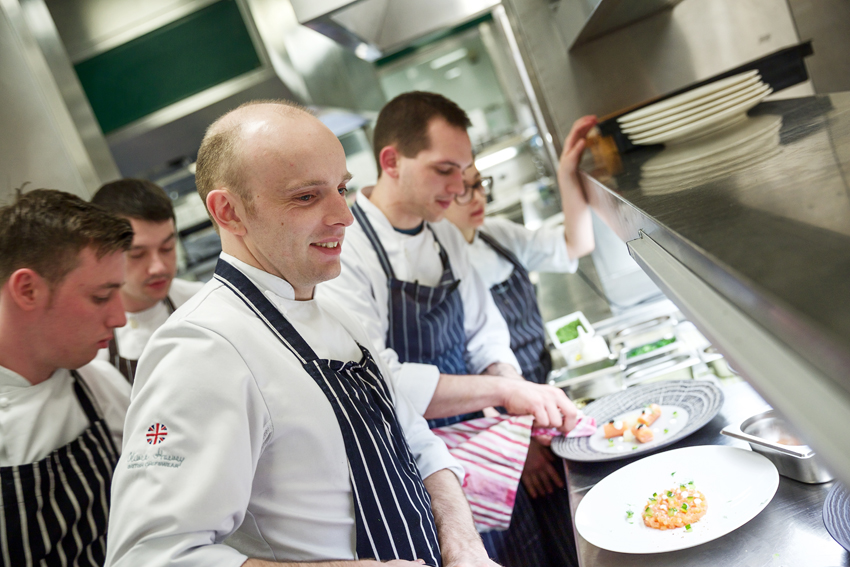
After a progressive spell in kitchens of increasing merit, Robby Jenks found himself working a trial for a spot in Michael Caines kitchen.  The story is a fascinating one, a journey during which Robby worked 16-18 hour days for three and half years as he progressed through the sections at Gidleigh Park.  After later trials at The Square, Hibiscus and Whatley Manor, Robby then moved to work under two Michelin starred chef Martin Burge.  One year later the lure of a senior sous chef position took him back to Gidleigh Park for a further two years.  A Head chef position at Amberley Castle beckoned followed by arriving at The Vineyard near Newbury around the turn of 2016.  Interview conducted by Simon Carter and took place in The Vineyard dining room on Wednesday 8th February 2017.

Tell us some background about yourself.

At about the age of 14 or 15 I started washing up for a cousin who was a chef. It was Friday evening, Saturday and Sunday and back to school on Monday. I just really enjoyed the lifestyle and culture of the environment, very team orientated and going out together at night after work. It was almost like a little family.

Catering college didn’t feel right, I did two days full time and it simply didn’t stick. My parents advised me to get a qualification so I comprised and did a one day a week course while working the other five days in a local hotel. This was near where I lived which was fine for a while but soon it started to feel like I wanted something more so I started looking into the industry.

I found through research a place that had three AA Rosettes and that this accolade meant a form of quality and something that people in my profession aspired to achieve. The restaurant was near Exeter and so about an hour from my parents’ house. It was the first move away from home so it was a big decision.   I worked about a year there and was really enjoying the experience. I was dreaming of getting two or three rosettes in my career. There was lots of fun but after a while I felt there was more to be achieved and that something different was required to be fulfilled in my career.

After further research, I decided that I wanted Michelin experience and so applied somewhere fairly local in Gidleigh Park. After my initial email application, a whole year went by before I was contacted by Michael Caines. Michael explained that Gidleigh had been closed for refurbishment and were back in the business of looking for people.

I went for a trial and was immediately blown away – a different world – I was so far outside my comfort zone, people were asking me to do things and I didn’t even know what the ingredients were never mind what they wanted me to do with them. I remember the trial to this day, it was very humbling, everything was so big, scary, loud, bustling and just so different. It was a good day, I enjoyed it, but didn’t think for a minute that I had a chance to get a job in that kitchen.

I was there all day working along side his team and then Michael came in for evening service and the intensity went up yet another notch, even though it was a very tough place it was a truly amazing experience, and a complete contrast to walking out the back door at the end of the night and into the complete calm of the Devon countryside. An experience I got used to but at the time a revelation.

On my first day Michael told me he’d seen something in me that he liked in a proper potential chef. For over three and half years I worked 16-18 hour days. Hardest working time of my life. Started on the garnish and worked my way around the sections, it was a rollercoaster. It took about a year to feel as if I truly knew what I was doing and had properly broken into being an accepted part of the team, at which point the next new young recruit was coming into the kitchen.

The time I spent on hot starters was the most valuable of my career, it was where Michael Caines himself had made a reputation and I was eager to meet the high standards that he set in the kitchen. I owe Michael a lot; his nature is inspiring, enthusiastic, infectious, ambitious while at the same time nurturing and encouraging talent. He devoted a lot of time to people coming through and never tired of setting examples where needed. After I had made it to Junior Sous chef, Michael felt I would benefit from a fresh challenge and three trials over the space of a week were set up for me – at Hibiscus (Claude Bosi), The Square (Phil Howard) and Whatley Manor (Martin Burge) – when I got back from the week I had a long hard think about what to do next. I went to Whatley Manor partly as it was a contrast to the working environment of Gidleigh Park.

At Whatley, it was a calmer kitchen; the cooking processes were simpler but much more of them and much more in depth: Absolute precision with clean and clear flavours. You would taste, taste and taste again until it was absolutely right, which offered a different discipline. I also wanted to take a step back to Chef de Partie and be responsible properly for a section, which began on larder. Martin Burge was there every service from 9am in the morning so you were always working with the chef, which was great experience. I was there for a year before I got a call from Michael Caines with an offer of a Senior Sous at Gidleigh Park.

I went back there for two years, there were 28 in the kitchen having been on a rota of six one service in the early days so things had significantly moved on. I enjoyed a whole new experience there of being a leader as a Senior Sous chef, having to develop my own infectiousness, to manage people and processes instead of being managed.

After two years it was time to find my first head chef position, which proved to be at Amberley Castle. This opportunity gave me the chance to have a clean slate, to make my own decisions, to make my own mistakes and also to make my own success. It took around a year to understand how everything ran properly and to establish myself in the head chef role. It was a great learning experience and a successful one: The dining operation had been in difficult times with next to no covers lunch and dinner, within eighteen months the services were full, which is something I remain very proud of achieving.

I joined The Vineyard with all my cards on the table. I was up front and honest with Andrew McKenzie, who I must have met around 8 to 10 times before I actually joined. He knew all my strengths and weaknesses as well as the right environment for success at The Vineyard. One year later and we’re really into our stride…

How would you describe your style of cooking at The Vineyard?

I believe a style changes, adapts and develops over time; A journey on which you may ultimately find a signature but even then an evolution continues to occur. At the moment we’re looking at how, given a classical style of cooking, less can mean more to the end product, just because a particular garnish has been used before, is it necessary? My belief is that you learn as you go and I will always be adapting my dishes.

The style will be the signature of the future for me rather than a specific dish. If a dish is great it will need constant attention to be adapted to meet the changing needs and perceptions of the customers to be as close to “perfect” as you can make it at any given time.   I hope that one day you’ll eat a plate of my food and say straight away that’s Robby Jenks’ food – not because you know it as one of my recipes, like Pierre Koffmann is known for Scallop and Squid Ink, or Pistachio Souffle or Pig’s Trotter – but because of the signature style of the dish. At the moment I like to think my style is classical based but progressive, moving forwards and modern.

Describe the menus currently on offer?

We have a discovery menu which is aimed at finding new flavour combinations and that goes for the wine as well as the food. This is a five course menu. There’s the judgement of Paris seven course menu and an a la Carte with five choices in each course. A set lunch is four choices per course.

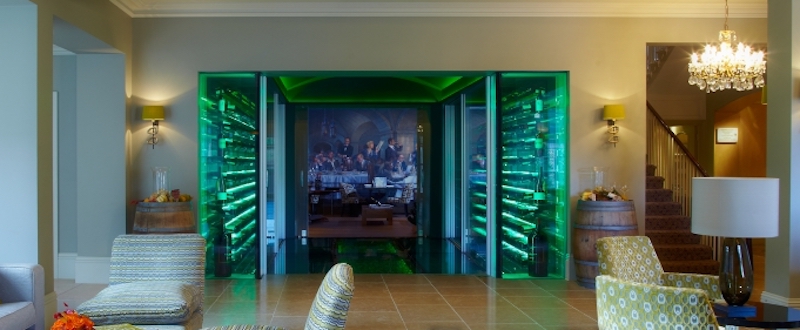
The accent is on the wine, it is a key feature of the Vineyard hotel and the restaurant. So the food will enhance the wine as well as vice versa. The Judgement of Paris dinner is about comparing the French and Californian wines, which was originally done as a blind tasting. This is the subject of the large painting as you enter the Vineyard and walk through the cellar archway.

What’s your kitchen management philosophy?

Promoting and developing from within, for example should I have a Senior Sous position become available then essentially I should need to recruit a commis.

I like to think that I’m one of today’s head chefs in that it’s an open door, you won’t get shut down for having ideas of your own! You have a good idea that’s maybe an improvement then we’ll take it on board and implement that idea. Likewise if what we are doing is currently right for the kitchen, we may discuss ideas but put them to one side. This approach is actually different from the old school dictatorial style of kitchen management, having said that you do need discipline, especially in a big kitchen like we have here: If you let people think you are a walk over then that’s exactly what they’ll do, so discipline and hierarchy remains important to get the right jobs done as quickly, efficiently and effectively as possible.

What is the size of the brigade in the kitchen?

Twenty five to cover the whole hotel seven days a week. Twenty of those are chefs. There’s breakfast, lunch and dinner in the main dining room plus food requirements of the bar plus 24 hour room service.

I have a lot of creative freedom as structures are in place to ensure day to day operational matters are taken care of which allows me to focus on more strategic issues such as creative menu direction and development.

How would you describe the front/back of house communication at The Vineyard?

We are all civil and respectful to each other. I like to think that we’re on the same journey together and aiming to please the business and the customers. There’s also the mantra that knowledge is cool, knowledge is key. So from my point of view, spec sheets, briefings, food combination explanations, food provenance, how and why dishes are created, as well as tastings are all organised for all the staff. This provides optimum knowledge, pride and ownership of the end products.

What do you think of social media platforms?

Relevant in today’s world although I’m not as active as I was before, perhaps my idea is that the marketing department can take photos of the food and write captions or maybe customer’s can take pictures and write about The Vineyard on social media as feedback. As I’ve got older I don’t feel the need to be on social media as some form of validation, I’d have better uses of my time. Being proud of your work and marketing your product is fine though.

…and feedback sites like trip advisor?

Any feedback is good and sometimes I learn something important. I prefer problems to be resolved at the time rather than publicly over trip advisor. Should there be genuine improvements over venting then I take it all on board. I check the web weekly.

What is your view of inspector led guides like Michelin?

I love the Michelin Guide. An ambition is a Michelin star. I like to think they watch chefs grow as people and cooks and reward them when they are ready. Perhaps it may come when you least expect it, they are like a romantic dream.

What are your ambitions for the future?

To keep evolving, to keep looking at improvement, to mature into a fundamental style that hopefully leads to having a restaurant with Michelin stars that has its own legacy that I continue to work at every day!!

Restaurant Review: Indian Essence, Orpington (Jan 2017)

Posted on: January 28th, 2017 by Simon Carter

indian-essence-exterior

Orpington, a London suburb just 30 minutes by train from Victoria, used to be synonymous with a rather patronising notion of the aspirant middle class. The stereotype was so engrained in class-obsessed post-war Britain that ‘Orpington man’ became an early pejorative figure. However, today’s Orpington would be characterised quite differently, particularly the leafy and the prosperous area of Petts Wood. With excellent connections to inner London and a good catchment of potential clientele, this is exactly the kind of outer London area that provides great opportunities for the savvy restaurateur.

With the benefit of local knowledge provided by his business partner, Jatindar Singh, it is little surprise that Atul Kochhar seized upon this opportunity by opening Indian Essence in 2012. Today this joins Benares, Sindhu and a host of overseas ventures in the growing business empire of Kochhar and Singh.

Less than five minutes’ walk from Petts Wood Station, the restaurant occupies an unassuming spot amongst shops and other eateries. On a cold Monday evening in January, when the streets were quiet and a number of other restaurants closed, Indian Essence managed to draw in a decent crowd. Clearly this is a placed loved by locals as many of those dining appeared to be celebrating special occasions.

indian-essence-interior

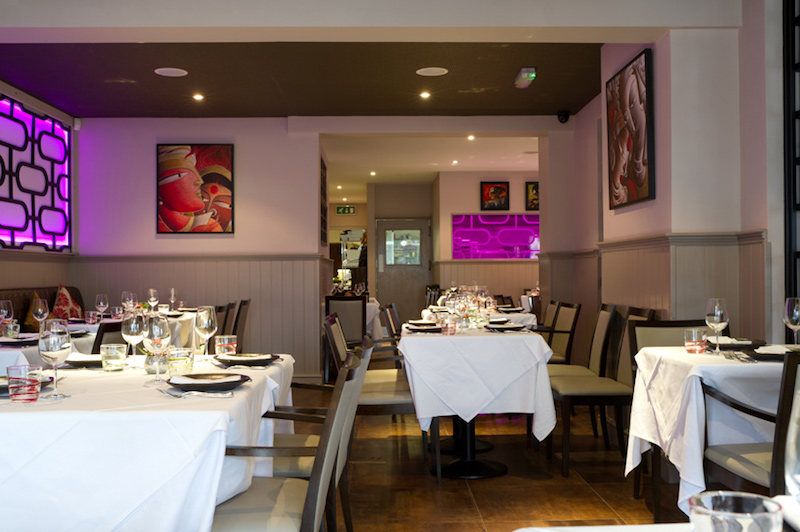
Inside the restaurant we found a light and airy space, comfortably accommodating 78 covers. The carefully chosen décor of neutral tones makes a focal point of the large picture window into the kitchen. The furniture is comfortable and tables dressed in fine napery are sufficiently spaced as to make the presence of other diners unobtrusive.

Indian Essence is billed as a neighbourhood restaurant; however it seems impossible for a chef with the acclaim of Atul Kochhar to deliver anything but a destination product. Kochhar gained his first Michelin star whilst Head Chef at Tamarind and then a second for Benares. He plays an active role in development of the menu at Indian Essence and its head chef, Kuldip, regularly visits him at his development kitchen in West London. As witnessed on our visit, his cooking retains the integrity of Indian regional cooking with inventive modern touches.

On our visit we were sampling the tasting menu which was preceded by cocktails and poppadoms. The Passion Fruit Martini was astringent and slightly sour, a perfect palate cleansing combination of flavours. The Ginger and Pineapple Mojito was equally refreshing and both drinks were complimented perfectly by mini poppadoms and a trio of fruit chutneys (mango, apple and tomato).

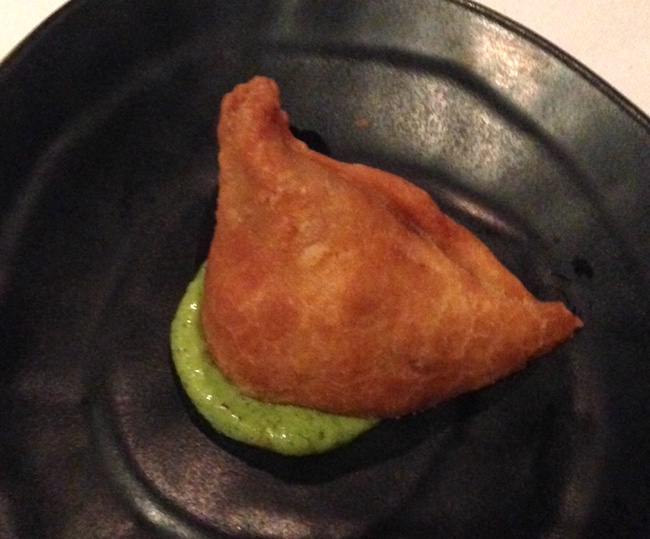
With appetites whetted, the amuse bouche arrived promptly. This comprised of a vegetable samosa, classically filled with potato and peas. The accompanying dressing of coriander, mint and mango lightened the dish and left a fresh taste. The excellent timing in the delivery of this and all of subsequent courses – perfectly anticipating when we were ready to progress to the next course but never feeling hurried – was a hallmark of the efficient service which was clearly a tight collaboration between kitchen and front of house teams.

IndianEssence_SamosaAmuse

The first course, a variation on Aloo Tikki, saw the addition of dates and pomegranate which added sweetness alongside the savoury potato and sour tamarind. Traditionally plain, salted yoghurt would also be served, however in this case the yoghurt appeared to have been whipped, changing the texture of the dish. The overall result was lighter, slightly sweeter dish, which was well suited to a multi-course menu and perfectly matched by the accompanying Chablis.

IndianEssence_alooChat

Next we sampled a fish course, of King Prawn and Kingfish, cooked in the Tandoor. Needless to say, the extremely high temperature of the traditional clay oven has the potential to risk overcooking and is a test of the most competent of chefs. Thankfully, this was a test the kitchen team passed with flying colours. Both the Kingfish and the King Prawn were moist and succulent, enhanced by the slightly smoky flavours resulting from the tandoor method of cooking. A classic Guwurtztriminer provided an enjoyable and suitably aromatic accompaniment.

IndianEssence_KingfishKingPrawn

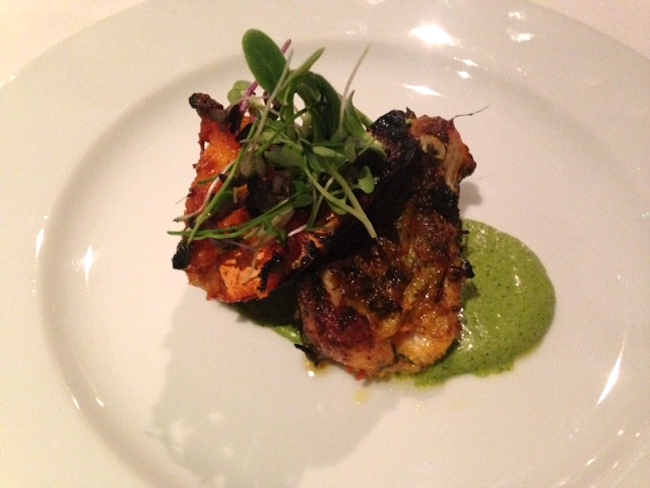
After a palate cleansing raspberry and strawberry sorbet, it was time for an intermediary course of Tandoori Murgh Makhanwala, which was served with a raisin pilaf. The variation on the word Makhani, meaning ‘with butter’ suggested we should be for a rich and heavy dish, however what was served to us was much more delicate and full of subtle flavours. The chicken was once again cooked tandoori style, however this time instead of being served dry it sat atop a flavoursome sauce. The pilaf was an excellent partner to the main dish, providing a canvas on which the full flavours came to life. The chicken and sauce were so gently spiced that any trace of heat was imperceptible and the predominant flavour was of tomato and ever so slightly sweet. Unusually perhaps for a white meat course, this was served with a very pleasant Pinor Noir.

IndianEssence_Chicken

The main course on the tasting menu provides a choice of either Fish (Mangu Chara Cod) or Textures of Lamb.

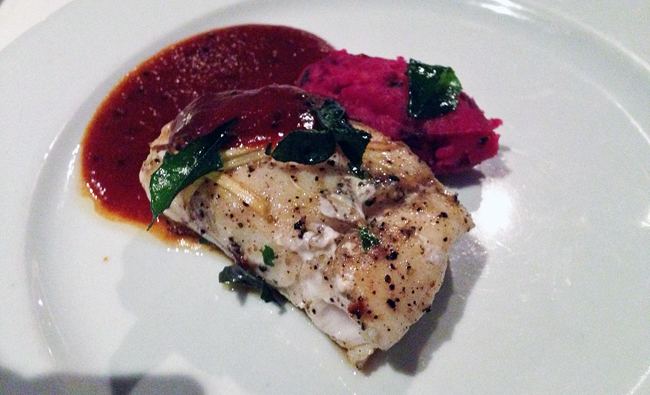
The fish option was a generous fillet of cod, which had marinated with Malvani spices and then pan seared. It was served with potato and beetroot mash and a garlic and date sauce. Malvani cooking can be very hot however this dish was gentle and did little to measure on the Scoville scale. It did however make good use of subtle flavours such as the date and beetroot. The fish was also expertly cooked, resulting in a good texture and succulence.

IndianEssence_Cod

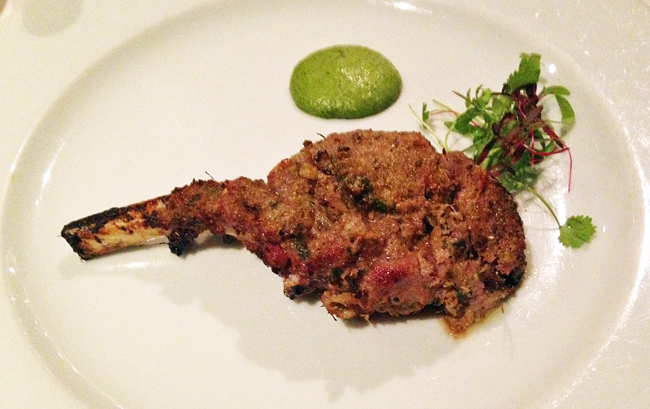
The lamb was our favourite of the two dishes, with the contrasting textures and methods of cooking working extremely well. The lamb chop was soft and tender and the fat had been rendered properly to yield maximum flavour without charring any of the meat. The fennel based marinade was absolutely delicious and both flavoured and protected the meat during the cooking process.

IndianEssence_LambChop

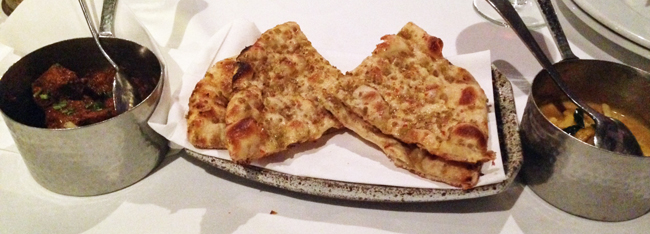
The contrasting texture was provided by a Lamb Bhuna Gosht, which had been slow cooked and melted in the mouth. The sauce of the bhuna was rich and meaty and we were certain to mop up every last drop! The third element to accompany the lamb was a Daal Makhni, a vegetarian lentil dish, prepared with butter. The daal was simple in terms of its flavour profile and provided a pleasant contrast to the intensity of the meat dishes.

IndianEssence_Curries

To accompany the main course we enjoyed a basket of naan bread, which were flavoured with Mediterranean ingredients such as olive and tomato. These flavours worked well with the main course and complimented both the lamb and cod dishes. The texture of the bread was soft and the dough seemed to have been enriched, resulting in a texture a bit like fougasse.

A very drinkable Cabernet Sauvignon accompanied both of the main courses.

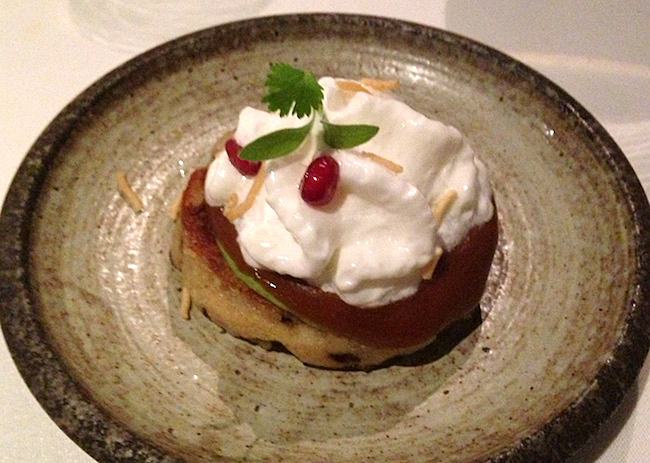
Finally, the meal was finished with Almond Halwa and Chocolate truffle flan. This was dense and intensely rich and so a small portion of was more than sufficient. A light and creamy almond kulfi rounded off the sweet and provided a cooling end to the meal. A glass of Sauternes was an over-indulgence but very pleasantly ended the meal.

IndianEssence_Choc

The tasting menu takes a culinary tour of the Indian continent, fusing together elements inspired by different regions and types of cooking. The overall effect is to distil an essence of Indian cuisine, as promised in the name of the restaurant. In each dish, the balance of flavours and textures was finely tuned. The only omission to this careful curation is a hot curry; however given the potential to overpower other flavours; this seems likely to have been a conscious decision.

At £47.95 (£77.95 with wines), the tasting menu is excellent value as well as a tour de force of modern Indian cooking. For lunch Indian Essence offers even better value, with two courses available at only £14.50. With highly courteous and efficient service to boot, Orpington man is onto a good thing!

Feature: Roux Scholarship 2017 Press Release (Jan 2017)

Posted on: January 18th, 2017 by Simon Carter

Anne-Sophie Pic revealed as honorary president of judges at Roux Scholarship 2017.

Roux ScholarshipInnovative three star Michelin chef, Anne-Sophie Pic will join the Roux family as honorary president of the judges at this year’s Roux Scholarship final.

Anne-Sophie Pic’s story is both remarkable and inspiring. In 2007, she became the fourth female chef to achieve three Michelin stars and the only woman to hold three stars at a restaurant in France, Anne-Sophie Pic, in Valence. In 2011, The World’s 50 Best Restaurants named her World’s Best Female Chef.

A total of six Michelin stars to her name; she holds two stars for Anne-Sophie Pic, in Lausanne, Switzerland and a sixth for La Dame de Pic in Paris. Anne-Sophie’s next challenge is to open her first restaurant in London, La Dame de Pic at the Four Seasons Hotel, Ten Trinity Square. Opening at the end of January 2017 it will feature the modern French cuisine for which she is famous.

Michel Roux, OBE: “We must congratulate Anne-Sophie Pic for the true leadership she is displaying by becoming guest president of the judges. And be thankful that despite spreading her wings in Europe and her increasing workload, this remarkable lady commits to spurring on the next generation. In particular, I hope this message encourages more female chefs in the UK to enter the Roux Scholarship.”

Anne-Sophie Pic: “I feel very honoured, to be involved with the 2017 Roux Scholarship, it is an interesting competition, emphasising both tradition and innovation. I believe that these two values are the two sides of the same coin. Within the tradition there is the idea of know-how and transmission, which are key to make the cuisine of a country lasting. I think one needs to know where he comes from to know where he wants to go. The question of roots is important to build our own path in life.

What I find really exciting about the Roux competition is that, from a classic recipe, there is a lot about taste and interpretation. I am sure I will be amazed by the creations of these young chefs. I am very impatient to discover all these talents!”

Michel Roux Jr: “Anne Sophie Pic is one of the most brilliant stars of French gastronomy, combining exotic spices and flavours with classic techniques. There is a purity that flows through every dish that never fails to delight.”

Alain Roux: “For many people, the name “Pic” says it all. As one of the few female three star Michelin chefs, she is highly respected, not only in France but internationally offering inspiration to all aspiring chefs. Chef Pic’s style of food, her interesting yet subtle approach and creative use of quality seasonal ingredients is exceptional. She powerfully combines a feminine finesse with unique flair sometimes creating unusual combinations but always guided by an excellent palate ensuring she gets the most out of her dishes. For me, having worked myself at Maison Pic, it is simply bringing the family back together again
which is always lovely.”

Roux Scholarship 2017 closes at midnight on 31st January.

There is still time for aspiring scholars to enter and win the chance to cook for chef Pic at the final. Simply submit a recipe for four people using this year’s ingredients: One whole fresh rainbow trout (1.5 – 2kg), 800g live mussels, accompanied by two garnishes, one of jasmine rice and a second of your choice. A sauce must accompany the dish. To apply go to www.rouxscholarship.co.uk for the full details and the competition rules.

The judges will select the best 18 recipes from those submitted. These chefs will be invited to cook their dish and a ‘mystery box’ dessert challenge at regional finals to be held in Birmingham and London on Thursday 23rd March 2017. Six winners will go through to the final cook-off.

Chef Pic will head the panel of judges alongside joint chairmen Alain and Michel Jr, the final will take place at Westminster Kingsway College London on Monday 10th April 2017. They will be joined by James Martin, David Nicholls, Brian Turner, first scholar Andrew Fairlie as well as previous winners Simon Hulstone (2003 scholar), Sat Bains (1999 scholar) and André Garrett (2002 scholar).

At the final, six finalists will be given a recipe and ingredients for a main dish, either classic or modern and three hours to prepare and present it to the judges. The winner will be announced at a prestigious award ceremony at The Langham, London, that same evening.

Live stream of Award Ceremony

Fans of the competition can tune in live from 7pm on Monday 10th April via www.rouxscholarship.co.uk to enjoy the full ceremony including behind the scenes films and a master class of the final dish by Michel Jr and Alain Roux. The event will culminate with the Roux family announcing the name of the winner in front of an audience of prestigious guests from the world of hospitality.

Our sponsors

The Roux Scholarship is sponsored by a number of companies including: Aubrey Allen, Bridor, Cactus TV, The Caterer, Direct Seafoods, Global Knives, Hildon Natural Mineral Water, The Langham London, Champagne Laurent-Perrier, L’Unico Caffe Musetti, Mash Purveyors Ltd, Oritain, Qatar Airways, Restaurant Associates, TRUEfoods, and Udale Speciality Foods Ltd.

More details about each of our sponsors are available on our website www.rouxscholarship.co.uk

AA Restaurant Guide Rosette Awards Press Release (Jan 2017)

Posted on: January 18th, 2017 by Simon Carter

AA ANNOUNCES NEW MULTI ROSETTE AWARDS . FIRST EVER FIVE AA ROSETTE AWARD IN JANUARY.

AARosettes2017

 The AA has been awarding Rosettes to restaurants since 1956, with the top award of five rosettes being introduced in 1991.  The multi rosettes are awarded bi-annually in January and September and for the first time this year the AA is announcing a new Five Rosette award in January.

Gidleighwignall

The restaurant achieving this coveted five AA Rosette award is Gidleigh Park in Devon.  Michael Wignall (pictured), one of the country’s most respected chefs, moved to Gidleigh Park in January 2016.  He is well known for having a great respect for food and an ever evolving style which creates unique dishes full of flavour, underpinned by a contemporary, less formal approach to fine cuisine.

Alistair Sandall, Commercial Manager at AA Hotel Services said, ‘While the awarding of new five rosettes is usually included in our main Hospitality Awards in September we all felt that we could not delay this award until then.  Michael Wignall has transferred his exquisite skills and style to Gidleigh Park and has made this undoubtedly worthy of this accolade.’ 

The restaurants awarded new four AA Rosettes are –

  • Martin Wishart at Loch Lomond, Balloch
  • Morston Hall, Blakeney, Norfolk
  • Typing Room, London E2

The new three AA Rosettes restaurants are –

  • AG’s Restaurant at Alexander House Hotel, Turners Hill, Crawley
  • Anglo, London EC1
  • Boringdon Hall Hotel (Gallery Restaurant), Plymouth
  • Bovey Castle, Moretonhampstead
  • Céleste at The Lanesborough, London SW1
  • Crossbasket Castle, Blantyre
  • Inver Restaurant, Strachur
  • The Elderflower Restaurant, Lymington
  • The Mount Somerset Hotel and Spa, Taunton
  • The Olive Room, Ilfracombe
  • The Square, London W1
  • Tuddenham Mill, Newmarket

Restaurants awarded three AA Rosettes are all outstanding restaurants that achieve standards that demand national recognition well beyond their local area while those achieving four AA Rosettes are among the top restaurants in the country.  To achieve five AA Rosettes, the restaurants are the pinnacle of the nation’s restaurants where the cooking compares with the best in the world and exhibit breath taking culinary skills and set the standards to which other aspire to and yet few achieve.

Gidleigh Park

As you round the corner on the long, winding drive on the edge of Dartmoor, the sprawling half-timbered mansion materialises against a lush backdrop of trees, with the River Teign flowing languidly past the front. The Aussie shipping magnate who built the property in the Arts and Crafts style in the late 1920s obviously intended to show his guests that he was a chap of substance, and it still gets jaws dropping today. It’s a charming and stylish place of impressively high standards, fully in tune with the needs of 21st-century sybarites, so everything is set up for pure indulgence and relaxation – there’s even a hot tub on the roof these days – and something would be amiss is there wasn’t an A-list dining option.There is: Gidleigh Park has one of the top restaurants in the country. The place was already in the Premier League of country house destination dining thanks to the long residency of chef Michael Caines – big boots for any successor to fill, but Michael Wignall (ex Pennyhill Park in Surrey) is a chef of the requisite calibre. He took the helm in 2016 and has shown that there are going to be thrills aplenty under the new regime. Wignall’s cooking is technically precise, clever without ever losing its way, and everything looks perfect on the plate.  A light touch means you can tackle the seven- or ten-course tasting menus without being overwhelmed, and meat-free versions of both ensure that veggies are not sidelined. Otherwise, the carte offers up five choices per course, or lunch is a good entry point if you want to get a measure of the place for pretty much half the price. Ensconced in oak-panelled majesty in one of the three dining rooms, you might as well splash out on some wine. An authoritative list of around 1,300 bins awaits, with a knowledgeable and enthusiastic sommelier to steer the way.

Martin Wishart at Loch Lomond

These days, just about every name chef has a place in the city and somewhere in the countryside, and Edinburgh star Martin Wishart has a gorgeously sited venue on a bank of Loch Lomond, probably literally a stone’s skim from the front door to the water’s edge. Naturally, views from the dining room are over the gently ruffled waters of the loch, and a little creative ruffling has been brought to the latest Ian Smith design job. Graeme Cheevers brings his own productive energies to the Wishart style, which matches a strong commitment to natural produce with head-turning visual display.

Morston Hall

On the edge of the Blakeney National Nature Reserve in coastal North Norfolk, Morston is a flint-knapped 17th Century country house with commanding views of the briny – a heaven-sent location for sourcing prime produce from land and sea. Inside, it’s a supremely civilised set-up, run for a quarter of a century with personable warmth and easy-going charm by chef-patron Galton Blackiston and wife Tracy. The conservatory dining room looks the part in delicate vernal green with fresh flowers abounding, and polished service ensures the evening runs like a well-choreographed routine. After aperitifs at seven, guests take their seats for the eight o’clock show that is the seven-course tasting menu. The pre-selected wine flight bears all the hallmarks of thoughtful selection based on testing and tasting, and is well worth the extra layout.

Typing Room

The old Bethnal Green town hall was built at the end of the Edwardian era, and is uniquely suited to have become a 21st-century hotel. The space where council memos were once hammered out on manual typewriters is now an independent dining room, designed along impeccable modern lines, including an open-to-view theatre kitchen with five evening shows a week and four lunch matinées. Time spent at international reference eateries Noma and Per Se, and productive periods under London maestros Tom Aikens and Jason Atherton, have refined Lee Westcott’s output to a rare pitch of concentrated creativity, and even where dishes look perfectly straightforward, they reveal unexpected depths of intensity from one mouthful to the next.

AG’s Restaurant at Alexander House Hotel

In a sprawling 120 acres of Sussex-Surrey borderland, the red-brick manor house is an architectural mash-up comprising a castellated neo-medieval turret and soaring factory-style chimneys. Inside, the designers have been busy funking up the bar and lounge with assertive splashes of psychedelic colour, but sensibly sticking to a more sober palette of royal-blue upholstery and white linen to reinforce the fine dining mood in AG’s, the principal dining room (there’s also a sleek brasserie called Reflections). Innovative technique and eye-catching presentations are the hallmarks of dishes that have their roots in the classical repertoire. Everything including the bread is made with craft and attention to detail, and it’s all backed by a compendious wine list.

Anglo

The new order of fine dining is to chuck out the chintz and proffer an unpretentious attitude, to focus on the ingredients and to maximise flavour with various whizzy techniques. The guys behind Anglo do just that, in a simple room with a light modern feel, the space watched over by a small service team who are as professional and informed as they are youthfully exuberant. Some plates are brought to the table by the chefs, which is also part of the new order. Owner Mark Jarvis is an experienced hand, having kicked off his career at Le Manoir over a decade ago, and head chef Jack Cashmore has Sat Bains on his impressive CV. They’re turning out some eye-catching food, inspired by British produce – hence Anglo – and offered up via a lunchtime à la carte and 5-course tasting menu, and a full-bore 7-course tasting menu in the evening. Everything arrives looking beautiful on attractive crockery, and flavours hit home.  Dinner comes with an optional wine and beer pairing for each dish.

Boringdon Hall Hotel

Only a few clicks outside Plymouth, Boringdon Hall is a spa hotel with a rich past. Back in the Tudor day, it became crown property during the Dissolution, and was then gifted by Henry VIII to one of his court favourites, Thomas Wriothesley, Earl of Southampton. Today’s attractive mix of stone walls and mullioned windows with ultra-mod spa facilities adds up to a powerful enticement, and the deal is surely sealed in the Gallery Restaurant, which, as its name suggests, overlooks the beamed Great Hall with its intricate carved furniture and little crannies. Scott Paton rules this roost, with food that is full of surprises and inventive energy.

Bovey Castle

Built in 1890 by one William Henry Smith (WH Smith to you and me), Bovey Castle was first opened as a ‘golfing hotel’ by the Great Western Railway company way back in 1930, and both associations are acknowledged in today’s dining options: Smith’s Brasserie and the big-hitting Great Western restaurant. It’s a property with a real sense of drama – big, bold, and glamorous, with a spa and that golf course to help pass the time until dinner. The Great Western is an equally lavishly done out space, suitably romantic with an art deco swagger. The kitchen is headed up by Mark Budd, a local chap who always had his eye on the top job here, and he hasn’t wasted any time making his mark. Regional ingredients from land and sea loom large in good-looking contemporary dishes that reveal well-honed technical skills and even a sense of fun.

Céleste at The Lanesborough

London is hardly short of gilded relics of empire, but this grand old mansion on Hyde Park Corner is in the Premier League. The Lanesborough offers a world-class level of luxury and service, but if your budget’s not up for stratospherically-priced rooms – personal butler included – you can sample the hotel’s oligarch-friendly glamour by booking a table at Céleste, the opulent dining room. And those tables come glistening with top-class crystal and silverware, beneath a glass-domed ceiling that reflects a trio of shimmering chandeliers, and blue and white friezes resembling delicate Wedgwood china. Modern French cuisine is the kitchen’s thing, cooked with top-level skill under the aegis of French super-chef Eric Frechon, although day-to-day delivery of the Frechon style is in the talented hands of head chef Florian Favario. The kitchen and über-professional front-of-house team may be as French as a camembert baguette, but the first-class materials underpinning the menu are resolutely British.

Crossbasket Castle

Crossbasket is a castellated beauty, dating in parts from the 16th century, and following a multi-million-pound refurbishment it can’t surely have looked this good in all its 500-year history. The luxurious, traditional decor is entirely in keeping with the building, with just nine sumptuous bedrooms to ensure a personal touch. The restaurant follows suit with its lavish colour scheme of red and gold, and with the names Albert and Michel Roux Jnr looming large, well, you just know the culinary bar is set very high too. The service is formal, professional and spot on, while head chef Alex Thain is the man charged with delivering on the promise of the Roux association. There’s evidence of classical thinking on the menu, alongside a light modern touch and contemporary ideas, and the wine list covers the globe while remaining true to the auld alliance.

Inver Restaurant

Pam Brunton and Rob Latimer have made quite a metaphorical splash on the shores of Loch Fyne. Their low-slung whitewashed cottage sits in splendid isolation by the water’s edge, and a well-designed interior spec provides contemporary simplicity tempered by a couple of real fires. A stack of vinyl records provides a cool backing track. If the interior brings to mind the purity of Scandinavian design, well, that is perhaps no coincidence, for Pam’s time spent at Noma in Copenhagen has helped inspire her culinary approach too (check out the cookbooks on show to find further clues). The menu reflects the seasons and the local terroir, and modern cooking techniques enhance the ingredients to maximum affect.  Children have their own wee menu, and the wine list, like everything else here, lifts the spirits.

The Elderflower

A moment’s stroll from the quay at Lymington, The Elderflower is a traditional-looking double-fronted restaurant in the old part of town, opened in 2014 by Andrew and Marjolaine Du Bourg, a partnership with its entwined roots in Yorkshire and the Charente. Low beamed ceilings and smartly linened tables establish a sympathetic ambience within, and Andrew’s menus, honed by valuable experience in many of London’s premier addresses, are overflowing with intelligence and enthusiasm.

The Mount Somerset Hotel & Spa

A handsome Regency pile in four acres of hilltop grounds, Somerset House lords it in the bosom of the Blackdown and Quantock Hills. Within, it’s the very template for classic country-house style, jazzed up with a modern note here and there, its period features – high ceilings, ornate plasterwork, polished wooden floors, open fireplaces, and a sweeping centrepiece staircase for when you feel the need to make a grand entrance – all remain pristine and play their part in building an air of luxury and refinement. New head chef Mark Potts has upped the kitchen’s game, steering a creative, contemporary country house line, and packing its menus with top-grade produce with West Country ingredients play a leading role.


The Olive Room

One of the most encouraging aspects of the contemporary dining scene is that a cutting-edge kitchen might as easily be found on the tranquil north Devon coast, not far from where the ferries depart for Lundy island, as in the metropolitan heartlands. So it is with Thomas Carr’s thrilling modern repertoire at The Olive Room, which at one glance is just the dining room of a local guest house, but at another is so much more. Cream walls and engaging staff set a relaxing tone, but the cooking will have you sitting up and taking notice, and there is a compact list of well-chosen wines to accompany.

The Square

A new era began for The Square in March 2016 when, after a quarter of a century at the helm, former owner and driving culinary force Philip Howard announced its sale to Marlon Abela. Fear not. Abela heads up a high-end transatlantic portfolio and knows a thing or two about the restaurant business, so the formidable reputation built here for refined modern French-oriented cuisine that utilises a wealth of thoroughbred British produce remains intact. The room was never a show-stopper, but it is refined and gently contemporary: abstract art on pearlescent walls, polished wooden floors and generously-spaced tables dressed up in pristine linen. This is Mayfair after all and dishes unashamedly mix high and humble.

Tuddenham Mill

The old mill may have ended its grinding days in the 1950s, but its heritage remains intact at the present-day boutique hotel. For one thing, the stream that turned its waterwheel has been dredged of centuries of silt and is now a thriving wildlife habitat, while the majestic wheel itself, framed by beams and glass walls, forms a diverting centrepiece to the first-floor restaurant. Head chef Lee Bye is a country boy with an instinctive feel for the surrounding region.  

Restaurant Review: The Perch, Binsey Nr Oxford (Dec 2016)

Posted on: January 5th, 2017 by Simon Carter

perchinterior

The Perch is nestled on the western edge of the city in the hamlet of Binsey.  This thatched pub, with its origins in the 17th Century, is accessible from the city either by a drive up Binsey Lane, a long single track road, or by foot on a delightful Thameside walk.  Thus, although you are unlikely to ever stumble upon The Perch by accident, the time spent getting there is worthwhile. On a dark winter’s evening, we took the least picturesque of those options. Clearly, another visit on foot in the summer, when the pub and its extensive gardens can be seen in all their glory, is essential.

perchgarden

Another advantage of its semi-rural location is the ample parking outside. Once inside the welcome is warm and the ambience relaxed. The open fire and log stacks, low ceilings, oak beams and exposed brickwork are classic features pleasing to the eye. In 2015, owner Jon Ellse lovingly renovated the old fashioned pub resulting in a modern gastro feel.

The main restaurant, conservatory, terrace and gardens can seat up to 200 in summer. A permanent marquee is also used for private functions. The conservatory where we had dinner on a weekday evening in December, was kept pleasantly warm by patio heaters.

Food at The Perch delights in its variety, simplicity and honesty. Dishes are freshly prepared and generously portioned. Combinations are classical rather than original but no less successful for that. Sourcing is important being local if possible, such as Kelmscott salami and chorizo, or regional, with squid from Brixham and fish and mussels from Cornwall.

A seasonally changing menu of eight starters, 11 mains and six desserts (including cheese) supplemented by daily specials, caters for all tastes. There is an unusually good choice for pescetarians and vegetarians. The former includes potted kiln smoked salmon, fish plate (beetroot cured salmon, kipper pate, house cured mackerel and crayfish cocktail), squid, sea bass, mussels, and fish and chips. Vegetarians will also be pleased with options including a veggie board, roasted cauliflower soup, globe artichoke with roasted heritage carrot, potato, parsnip and wild rice cakes, pumpkin and blue cheese tart, butternut squash with roast pepper and roast cauliflower. These dishes show the versatility of the kitchen, not that burgers, pies, pates and roasts are neglected; the venison suet crust pie which we almost chose, looked especially delicious.

PerchPie

A Sample Photo of a Pie at The Perch


Starters prices are very fair indeed, given the quality and quantity of the ingredients: starts range from £5.95 to £9.95, mains from £12.95 to £16.95, and desserts £5.50 to £5.95. English cheese and accompaniments are priced individually at £3.75 or four at £12.  An embarrassment of choice meant we had difficulty choosing.

The Butcher’s Board (£9.95) was an accomplished starter: the goose breast was gently smoked, enhancing its firm flesh and gamey flavour; home corned beef had a soft texture and a melting quality; game terrine was rich and well-seasoned; Kelmscott salami was deliciously spicy. Served with sweet pickles and gerkins which gave the acidic lift this charcuterie platter needed, this dish would easily satisfy any discerning trencherman’s appetite.

Perch Butchers Board

A surf and turf starter paired Brixham Squid with Kelmcott chorizo (£9.95). The seafood was accurately timed to be soft and firm without being rubbery. The chorizo offered a spicy hit, whilst sauteed Swiss chard and mustard crutons gave crunch and a mildly sweet and sour note. This was more contemporary starter in which all the ingredients worked well together.

perch squid

This could also be said of the seafood special of the day (£20) featuring king scallops. They were large, sweet, succulent and spankingly fresh, with a caramelised crust to add colour and flavour. Celeriac puree gave an earthy smoothness, rocket leafs a peppery freshness, and roast apple wedges provided a gentle acidity to cut the richness of the scallop. The addition of black pudding and Parma ham crisps added welcome savoury notes and contrasting texture, although for balance of the dish needed more of these elements.

perch scallop

A simpler main was Ale battered Cornish fish with triple cooked chips.   (£13.95). The freshness of the fish was irreproachable and the beer batter well made. However, it would have been even better if it had been cooked more crisp, as parts had an avoidable sogginess rendering it heavier than necessary. The chips were as they should be: crunchy outside and soft inside. A generous helping of well-made tartare sauce and minted peas completed this favourite classic.

The dessert menu featured classic winter warmers, perfect for a cold December evening, such as spiced poached pear with chocolate sauce, treacle sponge and fruit crumble. The latter featured a comforting spiced plum, blackberry and almond crumble. Served in a metal pie dish which emphasised its traditional Britishness, the buttery richness of the topping was a perfect partner for the autumnal fruit compote beneath. The accompanying scoop of ginger ice cream was smooth and well flavoured, also acting as a rich sauce as it melted.

perch crumble

Cold desserts included baked white chocolate and raspberry cheesecake and a selection of sorbets and ice creams. Spiced apple sorbet and coffee ice cream were velvety smooth and deeply flavoured.

perch sorbet

Overall, this was a very successful visit, the minor blemishes not detracting from the undoubted skill in the cooking. This was enhanced by the wine list, which avoided greedy mark ups and the efficient, courteous and knowledgeable service.

A short walk around the grounds afterwards reflected what a summertime gem this would be. With river frontage and plenty of outdoor seating, The Perch would be an ideal stop for anyone on a scenic walk from the nearby city. There is a shed bar, too, which serves beer on tap and burgers and other bites. Wonderfully simple but probably very effective.

Editorial: Corporations to Restaurants – The Staff Challenges (Dec 2016)

Posted on: December 22nd, 2016 by Simon Carter
multi national corps

A Take of Top 100 Global Multi-National Corporations (Source: Forbes 2014)


Post World-War II saw the large-scale expansion of the American multi-national corporation, so much so that hundreds of thousands of British jobs became dependent upon the phenomenon. In those early days it was not just about rampant wealth accumulation, most importantly there was a positive culture where employees felt an extension of family, a kind of corporate community spirit and a sense of genuine pride.

So offices were large and expenses not worried about so much, everybody did part of one job, unlike the comparative four jobs that people seem to do today. People wrote not emails but memos, the internal post department was huge, such memos were typed and sent in triplicate (sometimes more). People filed things and retrieved things from files. A lot.

The economic troubles of the 1970s (perhaps largely caused by a 1973 global oil price shock, which had nothing to do with UK government policy) saw rampant inflation and the rise of the UK Trades Union movement, a movement whose role was to represent the best interests of (mainly) government sector employees through the principles of collective bargaining.

acas

What we may later have considered an original QUANGO (QUasi-Autonomous Non-Governmental Organization), called ACAS (Advisory, Conciliation and Arbitration Service), was always very busy! It was an age remembered for endless strikes as wages failed to keep pace in the impossible race with inflation. By 1978 an inevitable recession had hit and hit very hard. 

The American multi-national corporation did not recognize UK Trades Unions but instead invented a separate department to verify their legal, and to an extent moral, responsibilities. The Amercian-ised version of Personnel, became the universal Human Resources.

The challenge for this department was that labour law in America (hire and fire) was the opposite to parts of Europe (France or Germany) and different again from Britain. Further expansion through Asia plus emerging markets in Africa and Latin America saw the significant need for growth of this function. HR departments were not just global or regional but necessarily local, too.

hr

From a UK legal perspective a company makes a role redundant, not a person. If a staff member is being let go and replaced in the same role, then either they have moved on within the company of their own volition, or they have resigned, or they have been managed out of the company on competency or performance grounds.

To do the latter requires a lot of process, time and effort. The employee needs to be aware they are being reviewed for performance or competency and have regular milestone meetings to measure and mutually agree their documented progress.

Let’s say it takes a middle manager of 8-10 staff, while also contributing their own value-added role, about 18 months to properly assess the contribution and performance of each team member. In the matrix-like structure of interdependencies that naturally makes up corporate life, the actual contribution of the individual is hard to quantifiably measure and assess.

The net result is that following and managing the process properly is a real headache for the manager, to the point where they may have the conversation that starts “You may be happier working in a different role in the organization.

The employee then moves sideways into a different role with a new manager, a manager who in 18 months time will likely move them along again. By this rationale you might have a 10 years career in a corporation, having worked in 5 different roles and not been competent in a single one!

sme

SME (Small to Medium Enterprise): Source: savings-banks.com


The SME (small to medium enterprise) is a different animal. Let’s say a firm that turns over less than £10m. There’s no hiding place. Staff contribution is measurable and visible by the hour. Nearly all staff will likely be on first name terms with the MD or CEO, who in turn know exactly what each staff member brings to the party. The tricky thing is that they certainly cannot afford the luxury of a £50k-£60k full-time Human Resources professional to tell them how to manage the turnover of their staff.

This is where things get a little tough; an SME does not have the size, scope nor slack to facilitate any number of staff not adding enough value in any particular role, moving sideways over time in their business. However, the rules about letting go of staff remain the same for these companies as they do for corporations. What do they do? Well, this scenario applies to full-time PAYE employment contracts, what alternatives exist?

Let’s consider top end restaurants, specifically those that do not belong to larger groups and those that turnover between £3m and £10m. Their cost base relates to their property and use of resources at the site; the cost of the ingredients on a plate, the cost of the cellar, but most of all it is the cost of their staff. Restaurants (and hotels) are labour intensive. They have big front of house, big back of house. Many staff would work long and sometimes unsociable hours. At the same time staff performance coupled with managed wage cost is crucial to the success of the business.

As a result employment contracts and shift patterns are different. How do they adjust to seasonality of demand for their product? How would you officially performance manage the career of a chef or a waiter? Or how would you move them on?

zero hour contracts

In essence, Zero Hours Contracts allow companies to hire and let go of staff as they wish. The stipulations are that the employee has a right to the National Minimum Wage and may seek alternative employment at any time without notice. The employer can take up their services as required but the employee has a right to refuse to work, although mutually agreed supplementary terms could be signed up to by both parties, for example stipulating a minimum of available hours work.  These contracts have proven emotive and controversial as they have been argued to be exploitative of the workforce, while on the other hand offering flexibility to both employer and employee.

The hotel and restaurant sector is proven to be the largest employer utilizing Zero Hours Contracts, see this interesting debate in The Guardian for background discussion https://www.theguardian.com/uk-news/2015/sep/02/number-of-workers-on-zero-hours-contracts-up-by-19

Zero Hours Contracts 2015

The Office of National Statistics chart (above) shows clearly the extent to which these contracts are prevalent in the industry; a sector that also happens to be one of the largest utilizers of the freedom of movement of labour in the EU (A separate Brexit impact discussion).

The UK National Living Wage was introduced for those over twenty-five years of age, to work in conjunction with the National Minimum Wage.  These are the rates as of  1 October 2016. Over 25 years of age becomes the National Living Wage which is set at £7.20 per hour; National Minimum Wage 21 to 24 years is £6.95 per hour, 18 to 21 years is £5.55 per hour, under 18 years of age is £4.00 and an apprentice is £3.40 per hour.

National Minimum Wage rates change every October. National Living Wage rates change every April. If an employee is on a Full Time Employment Contract then the relevant National Minimum Wage or National Living Wage still applies. So if a front of house or chef does 70 hours a week for 4 weeks on a full-time employment contract and their monthly pay slip is less than the 70 x 4 x relevant National Minimum Wage for that period then they have been illegally underpaid. The government website provides a simple process to calculate what an employee should be legally paid as a minimum, which can be found through the link provided. www.gov.uk/am-i-getting-minimum-wage/y/current_payment

It would appear that legally the definition of an apprenticeship is not met by staff training in the kitchen or the front of house www.gov.uk/apprenticeships-guide However, the early years of development remain critical to future longevity in the industry, including the possibility of running a kitchen or being a manager in a hotel at a relatively early age. The thinking is for practical education and training rather than a pure academic-led day release style of apprenticeship – Sue William’s conceived ‘ten out of ten’ programme would be close to the more hands-on type of process www.ten-outof-ten.co.uk, or The Roux Scholarship www.rouxscholarship.co.uk, or The Gold Service Scholarship for front of house professionals www.thegoldservicescholarship.co.uk

tenoutoften

An example of staff development training in hospitality (Source: ten-outof-ten.co.uk)


Nowadays company internships are the equivalent of staging in the kitchen or placements in the front of house of a restaurant. Those that have reached the top in the restaurant profession more than likely started working in a top restaurant or kitchen for free, never mind the modern day legalities of the minimum wage.

The top kitchens and dining rooms are a craft, an art, a profession that takes years of tutelage combined with a focused passion and dedication to master. When the leaders are interviewed they started humbly and made significant sacrifices both financially and with their social lives for some considerable time.

The top chefs of the world are always passing on their knowledge to the next generation, many who pass through their kitchen door go on to be leaders in their own right. The challenge is finding a structure that promotes loyalty, development and mutual respect; a system that pays fairly but maintains costs at a level that the restaurant business may sustain onwards into the future, building the talent of tomorrow in a positive atmosphere with a sustainable model that continues to produce consistent first class products today!

Restaurant Review: L’Ortolan, Shinfield (December 2016)

Posted on: December 8th, 2016 by Simon Carter

exterior lortolan

I’ve been coming to L’Ortolan since 1984 when it was called Milton Sandford, chef-proprietor Richard Milton Sandford having gained a Michelin star two years earlier. With little serious competition in the Reading area – the same is true today – it was a magnet for lovers of fine dining both locally and those from further afield. Certainly, I never regretted the 17 miles drive from Maidenhead.

The size of the handsome two storey red bricked building, once a rectory and then a private residence, has been increased with the addition of two conservatories, one a lounge for pre- and post- prandial drinks, the larger one called the Glass Room, as an extension of the main restaurant. An air of formality pervades the airy, high ceilinged dining room, with its large mirrors, well-spaced, tables dressed in fine napery and comfortable upholstered chairs. Nevertheless, there has always been a relaxed feel to the service, which has never been stiff nor condescending.

Over 36 years the restaurant has seen changes of ownership and name, with expansion and refurbishment. During this time it has consistently retained its Michelin-starred rating under a galaxy of five acclaimed chefs, two of whom, Nico Ladenis, who renamed the restaurant Chez Nico, and John Burton-Race, who changed the name to L’Ortolan, were awarded two Michelin stars.

For Nico and his wife, who acted as front of house and tried to dictate menu choices to the diner, the customer was never always right. Lamenting his move to the provinces, he disparaged the unsophisticated “gin and tonic brigade” who spent too much time at the bar before moving to their tables, hence he closed the bar. This hardly endeared himself to his clientele, many of whom already felt uncomfortable with his imperious style. So despite his exquisite gastronomy, Nico’s time in Shinfield (before his subsequent return to London) was destined to be short – less than a year.

The mercurial but inspirational John Burton-Race stayed 12 years longer, delighting his guests with sumptuous cooking. In the early days of tasting menus, (1993), I attended a commissioned seven course menu degustation with wines. This came about after having answered an ad in the Sunday Times for a fix priced tasting with wines at Pierre Koffmann’s then Michelin three-starred restaurant La Tante Claire in Chelsea. This experience proved such as success that our group contacted John Burton-Race directly to commission a similar arrangement; John’s response was warm and generous, and an extraordinary night at L’Ortolan followed: The tastes and textures of dishes such as confit of duck with pan fried foie gras or sea bass and scallops with parsley mousse and tomato coulis are as clear today as they were then. One of life’s great dining memories.

peter_newman

After John’s departure, my understanding is that the building lay empty for around 18 months awaiting a buyer, this buyer proved to be Peter Newman (left), who found over £1m cash in under a fortnight to take the property on and move it forward. Alan Murchison became Head Chef for most of the period 2001 to 2014, having been appointed by Peter Newman who had invested heavily and did so on an ongoing basis in a state of the art kitchen, a demonstration kitchen, enhancing two conservatories and developing two private dining rooms – the Champagne Room and the Wine Cellar – and refurbishments of the main dining room.

Moving more to a precise style of cooking, having learned from Inverlochy Castle and Le Manoir aux Quat’ Saisons, fine dining guide enjoyed many of Alan’s meals, the most memorable being a multi course dinner at the newly established kitchen table. This still exists today having been one of the first in the country, where customers may view and interact with the chef while sending out dishes from the passe. The modern version is a rather sophisticated upgrade from the original rickety bench and chairs.

Alan briefly moved on and Daniel Galmiche cooked Michelin starred food at L’Ortolan for a year, however, Alan Murchison made a return under new terms with proprietor Peter Newman to try and expand the business. This included a form of profit splitting service contract that allowed Murchison to watch the pennies but enjoy the creative freedom he had craved to maximise custom in every way he perceived viable.

Since Alan’s departure, the man who has always owned the building, Peter Newman, has taken direct control of the restaurant business. This is a refreshing change from the anonymity of many financial backers, who tend to keep at arms-length from the day to day running of the business.’  Chatting to Peter Newman later during the evening he demonstrated a clear excitement at the current project in progress at L’Ortolan restaurant.

chef tom clarke lortolan

Head Chef Tom Clarke, sous chef under Alan Murchison, then acting Head Chef after his departure, has more than justified the faith put in him. Having beaten off stiff competition for the position, he has retained the Michelin star held for 13 years by Alan Murchison. Having acquired his skills in the kitchens of the two Michelin starred Le Strato hotel in Courchevel and L’Oustau de Baumanière in Provence, Tom has refined them to a high degree at L’Ortolan, culminating in an exciting, distinctive style.

His modern British cooking, with European and Asian influences, is unashamedly complex. Multi component dishes, using top seasonal ingredients, give layers of flavour with balance of tastes and textures. Classical and contemporary technique are assured, timing is precise with imagination and skill shown in the sometimes unusual yet successful combination of ingredients. Foams and smears are kept to a minimum and clean presentation, on a variety of surfaces – wood, slate, stoneware and porcelain – is artful yet restrained. Menu descriptions are understated, adding an element of surprise when plates arrive at the table.

A recent meal demonstrated impressive attention to detail in every course.

The three breads offered, rosemary and sea salt focaccia, sour dough and granary roll were exemplary in their crisp crusts and firm crumb. The accompanying goat’s milk butter was infused with dill.

lortolan-Canapes

Delectable, labour intensive canapes excited the palate: creamy goat’s cheese and basil mousse sandwiched between parmesan biscuits and edged with shredded black olive combined strong, sharp tastes. Well-seasoned salmon tartare in a tuile cylinder was a delicate balance of soft and crisp textures. Best of all was a succulent warm duck terrine topped with quince puree which simply melted in the mouth.

lortolanamuse

An amuse bouche of shellfish bisque had a deep intensity enlivened with a truffle slice and coriander oil.

lortolanscallop

Next came a Japanese influenced dish. Seared scallops, with caramelised crust and soft, translucent flesh, were partnered with pickled mooli and cucumber. Interest was heightened by rounds of apple compressed with coriander oil and squid ink, bringing added texture and a gentle acidity. Smoked herring caviar acted as a seasoning. These elements were bought together by a subtle dashi nage with seaweed. Overall, this stunning dish showed highly creative flair moderated by a true understanding of flavour.

lortolan foie

A finely judged duck liver parfait on gingerbread puree did full justice to this delectable piece of offal. Rich and velvety, it married well with cubes and tuiles of pain d’epices which gave warmth and texture. The muted sweetness of blueberry and sweet wine jelly balanced the richness of the parfait.

lortolan stone bass

Skill in fish cookery was again seen in a fillet of pan fried Stone bass with crisp skin and glistening flakes of soft flesh. Delicate oyster tempura, with its foam and emulsion, added further layers of flavour, enhancing the main ingredient without overwhelming it. Segments of pink grapefruit added a hint of acidity to cut the richness of the dish whilst sea vegetables gave contrasting colour and texture.

lortolan venison

Venison loin in pancetta, precisely timed and rested to a medium rare, maximised the flavour and texture of this tender cut of game. Parsley root, beetroot parsley root and crispy kale provided earthy, autumnal garnishes. A gru de caco tuile – in an original touch – added a crisp note, the chocolate in this case remaining separate from the intense, reduced red wine and ruby port sauce.

Desserts showed the same refinement and sophistication as the savoury courses. They avoided being over sweet, with contrasting textures and tastes to maintain interest.

lortolan dessert pre

Chocolate and cardamom ganache worked well with mint ice cream, torched clementine and orange gel, chocolate tuile, spiced sweet wine puree. Here, the bitter, sweet, citric, herbal and spiced elements were in perfect balance.

lortolan dessert 1

Equally accomplished was a playful signature dessert – a toadstool of salted chocolate parfait and coffee marshmallow. Blueberry sorbet and gel provided a refreshing contrast, whilst matcha green tea cake and chocolate soil gave the necessary balance of flavour and texture.

Good coffee and petit fours completed a memorable meal which was enhanced by highly professional service that is knowledgeable and solicitous without being intrusive.

Clearly, Tom Clarke has blossomed, successfully emulating the achievements of his predecessors and is now a force to be reckoned with in this highly competitive field. Leading a brigade of ten he has created a cuisine of which he can be justifiably proud. Fine Dining Guide will visit more regularly and will follow his career with interest.

Restaurant Review: Shaun Dickens at the Boathouse, Henley (Nov 2016)

Posted on: November 4th, 2016 by Simon Carter

shaundickensattheboathouse

Henley-on-Thames, renowned for its annual Royal Regatta has also attracted visitors to a host of literary, musical and and food festivals. This idyllic Oxfordshire town has no shortage of restaurant and coffee house chains, pubs and tea shops. Surprisingly, however, the well to do residents and the ceaseless influx of tourists have, until recently, been deprived of restaurants of quality. Unlike its Thames-side neighbour Marlow, which has witnessed a gastronomic rejuvenation in recent years, Henley has remained largely untouched by such developments. This is why the opening of Shaun Dickens’ eponymous restaurant three years ago marked a watershed in the culinary fortunes of the town. No longer do those looking for high end, serious cooking have to seek it outside the town. Indeed, Shaun Dickens at the Boathouse is becoming a destination restaurant in its own right.

With three AA rosettes, entries in Michelin and the Good Food Guides, and local and national distinctions – Oxfordshire Best Restaurant and Best Gastronomic Restaurant of the Year 2014, and Tatler Best of Britain the same year – it has impressed in a short period of time. Surviving a flood just nine months after opening proved a blessing in disguise, allowing for restructuring and redesigning which have further improved its fortunes.

A discrete canopied entrance leads to the bar where a dramatic gossamer like curtain separates it from the restaurant. The elegant, wooden floored dining room with a maximum of 43 covers has well-spaced polished tables and comfortable upholstered chairs. The décor, in masculine tones of brown and cream is unfussy, with only a few abstract prints to detract from views of the Thames. In summer, al fresco dining on the terrace is popular, although a table by the open bifolding doors is equally attractive. In the evening, clever spotlighting creates a seductive, warm ambience.

shaun-dickensHaving trained in the Michelin starred kitchens of Le Manoir aux Quat Saisons, Per Se and L’Ortolan, Shaun Dickens has coupled their influence to his own fertile imagination and technical skill to create a distinctive style of modern British cookery. He acknowledges his debt to other inspirational chefs. For instance, the deft use of marigold leaves in a watermelon dish was inspired by Oliver Dabbous. Working with trusted local and regional producers ensures quality ingredients as an essential prerequisite.
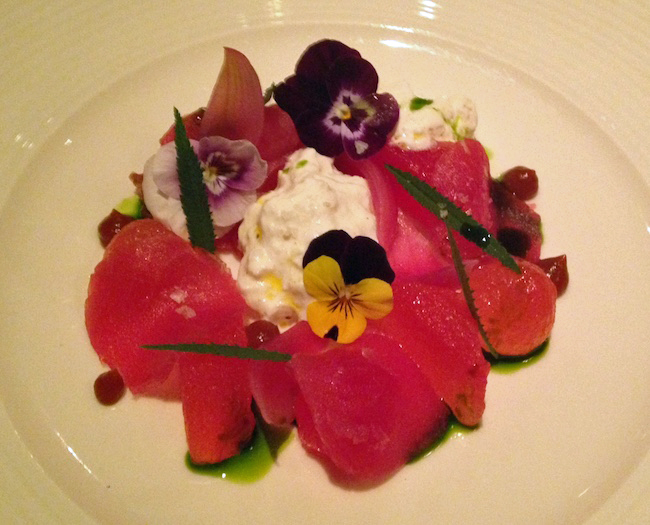
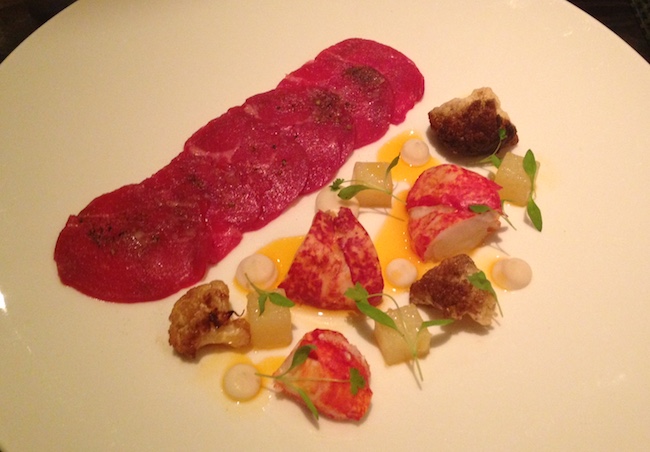
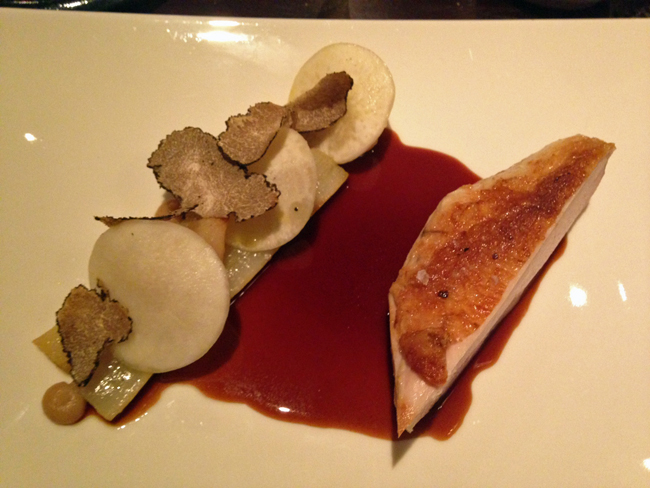
Novel yet harmonious combinations, often including lesser known or used ingredients, excite the diner. Pork neck braised in liquorice featured on a recent signature menu. His experimental cooking eschews conventional flavour combinations, being instead an exploration of the infinite variations of contemporary cuisine. Classical and modern techniques such as sous vide, compressing and torching maximise flavour and texture. Timing and temperatures are finely tuned, with a pleasing subtlety of taste in composite dishes, allowing each element to shine. Presentation is clean and precise, with a refreshing absence of smears and foams. There is a conscious artistry in the plating of dishes, without being too contrived. In chatting with Shaun, a youthful enthusiasm with a persistent desire to improve pervades his whole approach to his craft. He is a dedicated chef who, thankfully, does not take himself too seriously – after all, food “should be fun.” This is perfectly exemplified in a dish on his signature menu:

Smore, based on a traditional North American campfire treat, features marshmallows – diners are given a mini burner to toast them – and chocolate sauce sandwiched between two pieces of graham cracker. Messy, do it yourself, and hardly fine dining, but interactive and enjoyable.

A team of five in the kitchen create a la carte, tasting and signature menus and a good value fixed price option at lunchtime. Prices are realistic given the range of quality ingredients and the finesse in cooking. Menu descriptions are minimalistic, giving no indication of cooking method, adding an element of surprise.

A recent Lauren Perrier Dinner saw both innovative dishes and more conservative pairings.

Linseed and sorrel wholemeal breads, made on the premises, were exemplary in their crisp crusts and firm crumb.
A well flavoured amuse bouche of salt cod mousse, potato and leek veloute and potato crisp revealed strong attention to detail which augured well for the successive courses.

sd_starter

The first course featured watermelon as the star ingredient. Compression and charring – both fashionable techniques – produced a lively sweet and smoky taste with contrasting warm and cold temperatures. This worked well with tuna carpaccio and creamy buratta and stracciatella which balanced this dish with a creamy richness. Viola and Marigold leaves were not mere decorative flourishes but added a distinctive floral fragrance which lifted the dish. (Champagne: Laurent-Perrier Ultra Brut NV)


sd_beeflobster

Scottish beef carpaccio, the main element of second course, had perfect texture. It was eclipsed by a generous portion of accurately timed butter poached lobster, dressed with lobster oil. The shellfish was spankingly fresh, sweet and soft. Cauliflower florets roasted in beurre noisette, along with its puree, gave an earthy flavour and textural contrast. However, although the separate elements were well executed – apart from the carpaccio needing more seasoning –the pairing of beef with lobster seemed like two separate dishes. (Champagne: Laurent Perrier Cuvee Rose)

sd_Chicken

A breast of Creedy Carver chicken from Devon took pride of place in the main course. Gently cooked in a water bath, it was finished in the pan to crisp the skin, adding colour and flavour. Moist and tender, here was a superior ingredient treated with respect to enhance its inherent qualities. Partnered with braised salsify and turnip carpaccio which added crispness, truffle shavings which gave a heady but not overpowering fragrance, and a smoked potato espuma dressed with a hint of truffle oil, the components were bought together by an intense, rich jus. This well balanced dish, less adventurous than the other savoury courses, was nevertheless a triumph of taste and texture. (Champagne: Laurent Perrier Vintage 2006)

sd_choc

The complex, well executed dessert revealed the strengths of the pastry section of the kitchen. Chocolate parfait encasing a liquid centre of Henley honey was topped with blackberry puree and Italian meringue. Paired with frozen blackberry pieces, shaved chocolate and yoghurt sorbet, sweet and acidic elements were in perfect balance, making this a truly memorable composition.(Champagne: Laurent-Perrier Demi Sec.)

With only one minor blemish, this was a highly successful meal, and a good reflection of the restaurant’s consistently high standards. The seamless service, overseen by Gemma Dickens and Igor, the maitre d’, was welcoming, courteous and professional. Christie, who served us, showed a pleasing in depth knowledge of the dishes and presented the tempting selection of British cheeses – of which we were too full to partake – with interest and enthusiasm.

Like all chefs of his calibre, Shaun wishes to be recognised by his peers. In this respect, there could be no greater compliment than to have Raymond Blanc, his mentor for four years, name his restaurant as one of his favourite places to eat. Fine Dining Guide has enjoyed its visits to Shaun Dickens at the Boathouse and will follow its progress with interest, confident in the knowledge that further accolades will be awarded.

Map: Britain’s Top Restaurants (2017) Editions (Jan 2017)

Posted on: October 28th, 2016 by Simon Carter

This is a map that brings together the leading restaurants of Great Britain and Ireland according to three leading inspector-led guides 2017 editions (January 2017).  Each of the Guides outlined below provide data in publicly available press releases each year, or in the case of the AA Guide through cumulative twice yearly releases.  The points of note are as follows:

* The Waitrose Good Food Guide 2017 Top 50 are included and mapped.  The number in brackets next to the GFG score is the restaurant’s position within their top 50 list.

* The AA Restaurant Guide 2017 all 4 and 5 Rosette restaurants are mapped.

*The Michelin Guide 2017 all 2 and 3 Star restaurants are mapped.

Further points of note are as follows:

*The numbering of the labels is not significant and does not reflect any ranking, it is merely for convenience.

*There are many overlaps with these three mappings such that the final number of restaurants is 75.

Click on the expand icon on the right to go into google maps and use the full screen version.  Click on the icon on the left to see the menu of restaurants and their details.  Click on each number label on the map or on the menu on the left to see the scrollable restaurant details appear on the left hand side.


Newsletter: fine dining guide October 2016

Posted on: October 18th, 2016 by Simon Carter

Much to report after a busy remainder to 2015 which has continued through 2016.  The site maintained a focus on restaurant reviews supplemented with feature articles, interviews and broad guide coverage.

The iTunes podcast series remains – as always the links are to the written transcripts, you may find the podcast series on iTunes by typing “Restaurant Dining (UK)” into the main iTunes store search box.

itunes-podcasts-restaurant fine-dining-guide continues to have a YouTube Channel for which the site commissioned and uploaded a professional piece on The Waterside Inn featuring Michel Roux Snr.
YouTUbe Channel fine dining guide

The site has conducted eight interviews since the last newsletter spanning present and past Michelin Guide editors, a restaurant director, four chefs and a leading restaurateur.

octobernewsletter2016

Rebecca Burr, five years on from her first fine dining guide interview,  Rebecca spoke about the new live launch event (October 3 2016) for the 2017 Michelin GB&I Guide. An editorial comment also outlines a perspective on Michelin and a review of the launch event.

Thomas Mercier has more than 10 years in Michelin firmament restaurant dining rooms in the UK under his belt and shares some stories about his front of house exploits and philosophies.

Phil Howard is an iconic chef’s chef who has enjoyed 25 years at the top of the industry, now he plans to wear his chef’s whites at a new venture; Elystan Street restaurant. Article also includes an editorial comment on the state of play in top end restaurant styles.

Matt Worswick is formerly of Le Champignon Sauvage where he learned so much from mentor David Everitt-Matthias; Matt has gone on to earn his first Michelin star before moving to The Latymer at Pennyhill Park to develop his exciting brand of cooking.

Tom Sellers is something of a trail blazer in the modern chef world with a bold social media presence to match his extroardinary cooking. Restaurant Story is his focus but here he also talks about Restaurant Ours and his first book A Kind of Love Story.

Claude Bosi gives a full question and answer profile of his distinguished career to date as Hibiscus celebrated 15 years of operation across London and Ludlow.

Camellia Panjabi offers a full profile of Camillia’s distinguished career, rising through the corporate ranks in India to joining a formidable top end family run restaurateur team in London.

Derek Brown enjoyed a long and distinguished career at Michelin, where he took on executive responsibilities including Director of Michelin Red Guides (2000 to 2004), the first non-French holder of such a position. Derek speaks openly about his career, experiences and observations.

Twitter/Facebook/Instagram: The three social networking platforms continue to deliver good traffic to the site but also offer a shift to providing focus for photo logs, video logs along with a general news feed.  Indeed more and more unique content is appearing on these platforms as they offer a digital web presence for ‘fine dining guide’ in their own right – Facebook has over 2180 likes, Twitter enjoys over 7,190 followers and Instagram 665 followers. Each may be found using the handle @finediningguide.

Facebook and Twitter have progressively introduced more detailed analytical data about the performance of entries/tweets as well as the overall page/feed.  This proves very useful in tracking which information is considered most valuable to an audience and tailoring entries accordingly.

twitteranalytics

Apart from the analytics developments, two other aspects of note regarding Social Media:-

1) The new ‘Moments‘ feature in Twitter allows groups of tweets to be brought together under a common heading – these may be a collection of your own or other people’s tweets.  For example, fine dining guide used this feature to produce a ‘Guides Season 2017′ Moment and a “Memories of The Waterside Inn’ Moment.  This allows people to follow a kind of story about activity in a neatly top and and tailed way.  Instagram have introduced a similar-ish cut down version called ‘Story’

2) The length of video supported and editing facilities both on Twitter and Instagram have improved to rival Facebook as platforms of choice for multi-media.  Facebook itself is rivaling YouTube as a stand out video platform. fine dining guide has produced a number of one minute videos which have garnered a deal of success across the three platforms along with the longer videos found on YouTube.

socialmedia2

A Twitter ‘Moment’ (Above left) and (Right) one such one minute video on facebook which reached 98,000 people via 223 shares and completed 38,000 views.

Restaurant/Hotel Reviews: Reviews by Daniel Darwood have included numerous visits to venues from Edinburgh to the Lake District as well as around London and the home counties…  (See Reviews)

Guides: The 2017 GB Guide season took place during September 2016 (as applicable to fine-dining-guide). The ‘gold standard’ of Michelin Guide GB&I 2017 was eagerly anticipated with some buzz about the possibility of a new Michelin three star in GB&I.  In the event, one restaurant – The Raby Hunt – was promoted to two stars. The Fat Duck regained three stars after a one year hiatus, but otherwise no other new two or three star restaurants were awarded. Click on the map below to visit google maps and Telegraph Travel’s mapping of all Michelin Stars awarded in GB&I 2017.

mapgbi-michelin-stars-2017-newsletter

L’Enclume retained the lofty 10/10 in The Waitrose Good Food Guide 2017 and was joined by Restaurant Nathan Outlaw (10/10). These followed in the illustrious footsteps of Chez Nico, Restaurant Gordon Ramsay and The Fat Duck in achieving maximum marks. There were some new 5 AA Rosettes gained in the AA Restaurant Guide 2017 which included Hélène Darroze at The Connaught, Casamia Restaurant, Restaurant Story and Pollen Street Social.  The new 4 AA Rosettes were; The Whitebrook, Winteringham Fields, Number One The Balmoral, Hampton Manor, Paul Ainsworth at No 6 as well as The good Food Guide Restaurant of the Year – Orwells near Henley-on-Thames.  The year has seen a state of flux at The AA as Simon Numphud moved onto pastures new and his successor Peter Laigaard Jensen left after just four months in the lead role. Giovanna Grossi, a Hotel Services Group Area Manager at The AA, who was leaving after 17 years with the company was subsequently offered the opportunity to return in a newly created part-time role.

Top Restaurants

While still awaiting the January review of awards by the AA but with all three main guides for 2017 published, fine dining guide have updated the ‘Top 100’ feature that lists top restaurants in London, Scotland and Wales based on a formula applied to leading guides to give an FDG score per restaurant.  There is an associated Top 25 Restaurant in Britain 2017 feature.

Opinion/News: In the modern age the typical restaurant is becoming more and more relaxed, accessible and informal – but more than this – a form of social meeting place where you happen to have something to eat.  This trend is affecting every level of the industry, to the point where restaurants toward the top end are having to introduce more and more value add to the customer to keep the business running successfully.  This may be the chef coming out to introduce dishes with the occasional dry ice flourish (as with Matt Worswick at Pennyhill Park) or installing courses in a botanical gin room, a larder and a cellar as part of the tasting menu journey (in plan at Stovells) or the whole journey-instead-of-a-menu set up at The Fat Duck!

The idea of a top chef running a restaurant as a vent for his creativity in a menu-led, formal, temple of gastronomy is all but over.  Indeed, good old fashioned world class food, service and hospitality all now take on different meanings.  The long standing ‘service un-matched’ of The Waterside Inn was actually – from the club effect warmth of welcome to the theatrical service and hospitality – years ahead of its time in delivering a particular type of value add to the food offering.  So even the perceived ‘traditional’ in this case was actually prescient of the future needs of customers’ requirements.  Interviewing the iconic chef’s chef Phil Howard brought this train of thought to mind – the difference between his and Tom Aikens’ set up at the same venue is one eye opener and the difference between Elystan Street and The Square opens the other.  Phil Howard’s situation is somewhat different, as his new venture is in a completely different neighbourhood to his last, bringing with it a completely different set of needs. The observation of the social meeting place (with value-add to the customer) trend remains the same.

Not sure if it was fine dining guide’s imagination but the three Gudies – Michelin, Waitrose Good Food Guide and AA Restaurant Guide – all launched to more hoopla than usual.  While The Good Food Guide had a fairly low key lunch in London, they published a rumoured 100,000 copies and their press release went exceptionally hot on launch day. The AA awarded no less than four new 5 Rosette restaurants and Michelin produced a live launch event that was broadcast simultaneously over the web.  Michelin teamed up with sponsors for two new awards as well as a team of sponsors for the launch event.  Presumably this commercial move was initiated to protect the resources at Michelin in the digital age (during the move from print media) and thereby defend their quality, integrity and leadership position. This year at least, it appeared to work well and a strong turn out of chefs came to support the Michelin launch process.  We await with interest the actions of the guides to maintain their positions in the ever more dynamic world of top end restaurants and their demanding customer bases.

Until next time Happy Eating!